Key Takeaways
- Retinol works, but irritation is common at the start—your best “hack” is a slower schedule, a pea-sized amount, and serious moisturising.
- In Singapore, humidity + air-con + intense year-round UV can make skin feel oily and dehydrated—sunscreen and barrier support aren’t optional when you use retinoids.
- Think in months, not days: texture and acne can improve in weeks, but fine lines and pigment changes often take consistent use over 3–6+ months.
Introduction
If you’ve ever bought a retinol product with the best intentions… then stopped two weeks later because your face started peeling like you accidentally booked a chemical peel you didn’t ask for—same. Retinol is one of the most evidence-backed topical ingredients we have for acne, uneven texture, and photoageing. But it’s also one of the easiest to misuse, especially when you’re excited and want results yesterday. The problem isn’t that retinol is “too harsh” as a category. It’s that beginner skin needs a ramp-up period (often called retinisation) while your barrier adapts. This guide is built for real life in Singapore: sweaty commutes, indoor air-con, masks/helmets, and high UV all year round. We’ll go step-by-step through a retinol routine for beginners that helps you start retinol slowly, minimise irritation, and set realistic expectations—without babying you with vague advice.
Retinol 101 in Singapore: why beginners get irritated (and why our climate makes it trickier)
Before we talk routine, it helps to understand what retinol is actually doing—because the “why” makes the “how” much easier to stick with.
Retinol vs tretinoin vs adapalene: quick definitions (OTC vs prescription)
All three sit under the umbrella of retinoids(vitamin A derivatives), but they aren’t interchangeable:
- Retinol (usually OTC/cosmetic): needs conversion in skin before it becomes active. It’s often a gentler entry point, but still very capable of causing dryness and peeling if you go too fast.
- Tretinoin (prescription in many settings): already in active form (retinoic acid). More direct, often more irritating, and tends to come with clearer medical guidance and follow-up. MedlinePlus notes tretinoin can worsen acne early and may take months for anti-ageing changes. (medlineplus.gov)
- Adapalene (often OTC at lower strengths in some countries; prescription in others): designed for acne, generally better tolerated than tretinoin for some people.
If you’re a true beginner, starting with retinol(low strength, low frequency) is often the most forgiving approach—especially if your skin barrier is already borderline from over-exfoliating.
What retinoids do in skin (and why results take time)
Retinoids influence how skin cells mature and shed, and they’re involved in longer-term changes that relate to collagen support and photodamage. That’s the upside. The trade-off?
Your skin has to adapt—and the adaptation period is exactly when many people overreact (either by quitting too early or pushing harder and making the irritation worse).
Common early side effects: what’s “normal” vs what’s a red flag
Early irritation can look like:
- dryness and tightness
- redness (erythema)
- flaking/peeling
- stinging or burning
- itchiness
These reactions are well-described with topical tretinoin, and the same pattern often shows up with retinol—just usually milder if the formula is gentle and your schedule is conservative. MedlinePlus lists dryness, burning/stinging, peeling, redness, and even blistering as possible side effects with topical tretinoin. (medlineplus.gov)
Red flags (stop and seek medical advice):
- swelling, blistering, crusting
- persistent burning that doesn’t settle with moisturiser + reduced frequency
- rash/hives or significant pain
Who should not use topical retinoids (important safety screen)
If you’re pregnant, trying to conceive, or breastfeeding, don’t self-start a retinoid. Have a clinician guide you. MedlinePlus specifically advises: if you become pregnant while using topical tretinoin, call your doctor. (medlineplus.gov) Even though OTC retinol isn’t the same as prescription tretinoin, the conservative and common-sense approach is to avoid topical retinoids during pregnancy and get personalised advice if you’re TTC or breastfeeding.
The Singapore twist: humidity outside, air-con inside, UV everywhere
Here’s the thing many of us notice: skin can feel oily but still be dehydrated.
- Outdoors: sweat + humidity can increase occlusion (things sit on skin longer), plus friction from masks/helmets.
- Indoors: air-con can dry you out, making skin feel tight even if you’re shiny.
- UV: Singapore’s UV exposure is no joke year-round. Retinoids can make skin more reactive, and sun exposure can worsen irritation and post-inflammatory dark marks.
MedlinePlus explicitly recommends avoiding unnecessary sun/UV exposure while using tretinoin and wearing sunscreen. (medlineplus.gov) That guidance matters even more here because “high UV season” is basically… most days.
Choose your retinol (and apply it correctly at night): the barrier-first setup
A lot of retinol irritation isn’t about you “having sensitive skin”. It’s about using the wrong strength, the wrong format, or the wrong application strategy for your current barrier.
Before you start: pick a strength and format that matches your skin (not your ambition)
A beginner-friendly retinol routine for beginners usually wins with:
- lower strength
- lower frequency
- more moisturiser than you think you need
Even if a product label suggests nightly use, your barrier gets a vote. Starting slower doesn’t delay results as much as you fear—because the alternative is often inflamed skin that forces you to stop completely.
Serum vs cream vs encapsulated retinol: what’s the practical difference?
Let’s make this decision easier. Different formats change how easy it is to buffer irritation.
| Option | Pros | Best for | Notes for beginners |
|---|---|---|---|
| Option | Pros | Best for | Notes for beginners |
| Retinol serum | Often lightweight; layers easily | Oily skin in humid weather | Can sting more if alcohol/fragrance is high; needs a solid moisturiser on top |
| Retinol cream | More cushioning and emollient feel | Normal-to-dry skin; air-con dryness | Often easier to tolerate because the base can reduce the “raw” feel of retinol |
| Encapsulated / slow-release retinol | Potentially smoother delivery and less “hit” of irritation | Sensitive skin retinol tips; people prone to peeling | Check label for “encapsulated,” “time-release,” or delivery systems; still start slow |
| Retinol + barrier-support blend (ceramides/niacinamide/panthenol) | Helps support comfort while adapting | Beginners with reactive or compromised barrier | Example: formulas that include niacinamide, ceramides, and panthenol alongside retinol can feel more forgiving (nanosingaporeshop.com) |
How to read this table: choose the option that helps you stay consistent. Consistency beats intensity early on. If you’re peeling daily, you’re not “powering through”—you’re just inflaming your face on a schedule.
What to look for on the ingredient list (and what to avoid if you’re reactive)
Barrier-supportive helpers that often pair well with retinol:
- Ceramides (look for ceramide NP/AP/EOP, etc.)
- Niacinamide
- Panthenol (vitamin B5)
- Centella asiatica components (like madecassoside)
- Humectants like glycerin
For example, the ingredient list on Nano Singapore’s
Retinol Face Cream - 50g includes retinol plus multiple barrier-supporting ingredients such as niacinamide, madecassoside, centella asiatica extract, ceramides (NP/AS/AP/EOP/NS/NG), hydrogenated lecithin, beta-glucan, ectoin, and panthenol. (nanosingaporeshop.com) That kind of “retinol + cushioning” formula can be useful for beginners who want results but don’t want their skin barrier to hate them.
Potential irritants to be cautious with (especially in week 1–4):
- heavily fragranced formulas
- “tingly” blends loaded with essential oils
- high alcohol content
- stacking multiple actives in the same product (retinol + strong acids + strong vitamin C) when you’re still acclimatising
Also, packaging matters more than people realise. Retinol is sensitive to light/air, so opaque, well-sealed packaging is usually a plus.
Night routine basics: cleanse → dry skin → pea-sized retinol → moisturiser
This order sounds simple, but the details matter: 1.
Cleanse gently
Avoid harsh foaming cleansers that leave you squeaky-clean. That squeak is often your barrier waving a white flag. 2.
Wait until skin is fully dry
Applying retinoids onto damp skin can increase penetration and sting. 3.
Use the pea-sized rule
MedlinePlus describes applying tretinoin in a thin layer and using only enough to cover the area. (medlineplus.gov) For most faces, that’s about one pea-sized amount total, not a pea per cheek. 4.
Moisturise
MedlinePlus notes your doctor may tell you to use a moisturiser to help with dryness. (medlineplus.gov) Even if you’re oily in Singapore, moisturiser can reduce irritation and help you tolerate retinol long enough to see results.
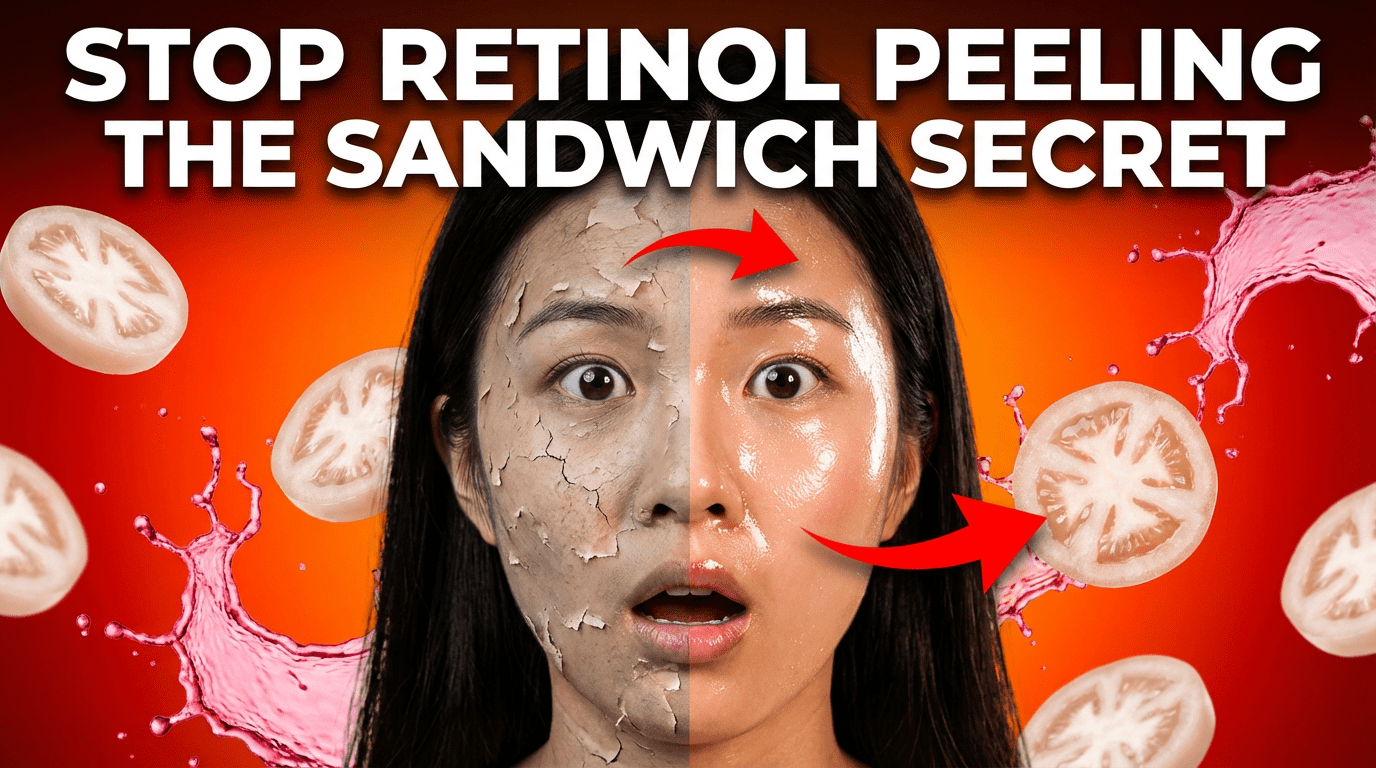
The moisturiser sandwich method: when it helps (and when it doesn’t)
Sandwich method = moisturiser → retinol → moisturiser
It helps when:
- you’re newly starting
- you’re peeling easily
- you’re using other acne meds
- you have a history of eczema-ish dryness
It may not be ideal when:
- your skin is already fully adapted and you want maximum impact
- you’re using a very gentle retinol and you’re not irritated at all
For most beginners, sandwiching is like using training wheels. You can take it off later.
Where NOT to apply (this alone prevents a lot of misery)
Avoid:
- eyelids and lash line
- corners of nose
- corners of mouth
- directly on lips
MedlinePlus also warns not to get tretinoin in eyes, mouth, corners along the nose, and not to apply to eczema-affected skin. (medlineplus.gov) If you want to protect these areas, apply a thin layer of plain moisturiser there first as a buffer.
A note on Nano Singapore product use (without overthinking it)
If you’re looking for a single-step beginner product, a retinol cream that’s already paired with barrier-support ingredients can simplify your routine. Nano Singapore’s
Retinol Face Cream - 50g is one example, and you can review its full ingredient list before committing. Here’s the product page:
Retinol Face Cream - 50g. (nanosingaporeshop.com) If you’re the type who likes browsing and comparing, the broader catalogue is here:
All Products. (nanosingaporeshop.com) (Regardless of which brand you choose, the routine and ramp-up schedule below is what usually makes or breaks your experience.)
A 6-week ramp-up schedule (low and slow) + what to do if you get irritated
If there’s one mindset shift that protects your barrier, it’s this:
Your goal is to earn frequency—not force it.
The 6-week beginner schedule (adjustable, not a dare)
Week 1–2: 1 night per week
- Pick one consistent night (e.g., Wednesday).
- Keep the rest of your routine boring and soothing.
Week 3–4: 2 nights per week (spaced out)
- Example: Wednesday + Sunday
- Still avoid adding new actives.
Week 5–6: 3 nights per week (only if comfortable)
- Example: Monday + Thursday + Saturday
- If you’re even mildly struggling, hold at 2 nights/week. That’s not failure—that’s good judgement.
If irritation shows up, the fix is rarely “push through.” It’s usually:
- reduce frequency
- simplify routine
- add moisturiser
- stop other irritants
What “too irritated” looks like (and what to do the next day)
Mild irritation (manageable):
- slight flaking around mouth/nose
- mild sting when applying moisturiser
- temporary tightness
Do this:
- pause retinol for 3–7 days
- moisturise generously
- restart at the previous frequency (or half)
Moderate irritation (you should actively intervene):
- visible redness lasting all day
- burning that distracts you
- widespread peeling
Do this:
- stop retinol until calm
- use bland moisturiser only + sunscreen
- consider the sandwich method when you restart
- restart at 1 night/week again
Severe irritation (stop and get medical advice):
- swelling
- blistering/crusting
- persistent burning
- hives/rash
MedlinePlus lists blistering and significant swelling/redness as possible effects with topical tretinoin and notes serious symptoms should prompt medical attention. (medlineplus.gov)
Skin purging vs irritation: how to tell the difference (fast)
This is one of the most confusing beginner problems.
Purging is more likely when:
- breakouts happen in your usual acne zones
- it’s mostly small clogged bumps/whiteheads
- it starts within the first few weeks and gradually improves
Irritation breakout is more likely when:
- you suddenly break out in unusual areas
- your skin is burning, red, and raw
- you see lots of tiny inflamed bumps + peeling at the same time
When in doubt, treat it as irritation first (simplify + reduce frequency). Your barrier healing usually makes everything else easier to interpret.
Don’t wreck your barrier around hair removal and procedures
This is where people accidentally injure skin.
Waxing/threading:
Retinoids can make skin more fragile. Plan to pause retinoid use around hair removal, especially facial waxing, and test cautiously. (If you’re on prescription retinoids, ask your clinician for timing.)
Lasers, chemical peels, microneedling:
Always tell your provider you use a retinoid. Many clinics ask you to stop actives beforehand. Don’t freestyle this—procedures + retinoids + Singapore sun can be a perfect storm for irritation and pigment issues.
If you’re on common acne routines in Singapore (benzoyl peroxide, AHA/BHA)
Beginner rule: introduce one active at a time.
- If you’re using AHA/BHA: pause them for the first few weeks of retinol, then reintroduce slowly on non-retinol nights.
- If you’re using benzoyl peroxide: separate nights early on.
MedlinePlus specifically warns not to use other potentially irritating topical products (including benzoyl peroxide and salicylic acid) unless your doctor directs you, because irritation can be worse. (medlineplus.gov)
Pairing retinol with other actives (without wrecking your barrier) + the AM SPF plan that prevents dark marks
Once your schedule is stable, pairing becomes the next big question. And honestly, it’s where a lot of barrier damage happens—because people stack “all the good things” on the same night and wonder why their face rebels.
Sunscreen + retinol: the essential daytime partner
If you do only two things while using retinol, do these: 1) retinol at night (slow schedule) 2) sunscreen every morning MedlinePlus advises avoiding unnecessary sun/UV exposure and using sunscreen while using tretinoin. (medlineplus.gov) In Singapore, that’s not a polite suggestion—it’s how you reduce the risk of:
- sunburn
- prolonged irritation
- post-inflammatory hyperpigmentation (dark marks that linger)
Vitamin C: same day or alternate days?
If you’re sensitive:
- use vitamin C in the morning
- use retinol at night
- keep both formulas gentle
If you’re very reactive, alternate days at first.
AHA/BHA exfoliants: when to pause, when to reintroduce
In the first 3–4 weeks of retinol:
- pause strong exfoliants
- let your skin learn retinol first
Later (when stable at 2–3 nights/week):
- reintroduce exfoliation once weekly, on a non-retinol night
- avoid “peel” products until you’re confident your barrier is resilient
Benzoyl peroxide: separate nights early on
Especially for acne routines, it’s common to use benzoyl peroxide—but pairing it too aggressively with retinoids can be a fast track to irritation. A beginner-friendly approach:
- retinol nights: retinol + moisturiser only
- benzoyl peroxide nights: benzoyl peroxide + moisturiser only
- never combine until you know your skin can handle it
Again, MedlinePlus flags benzoyl peroxide as a product that may interact/irritate when used with tretinoin. (medlineplus.gov)
Niacinamide, ceramides, hyaluronic acid: your barrier-support “helpers”
These are the boring ingredients that quietly keep your routine together.
- Niacinamide can support barrier function and is often well-tolerated.
- Ceramides help reinforce the skin’s lipid structure (useful when you’re peeling).
- Hyaluronic acid/glycerin help with hydration—but if you live in air-con, don’t rely on humectants alone. Seal them with a moisturiser.
This is also why retinol formulas that include barrier helpers can be easier for beginners to stick with. For example, Nano Singapore’s retinol cream includes multiple ceramides, niacinamide, and panthenol alongside retinol. (nanosingaporeshop.com)
Morning routine in Singapore: the SPF plan you’ll actually follow
A practical AM routine: 1)
Cleanse lightly
If you’re dry from air-con, consider just rinsing or using a gentle cleanser. 2)
Moisturise
- Gel-cream if you’re oily
- Richer cream if you’re tight/peeling
3)
Broad-spectrum sunscreen
Pick one you can reapply without dread. If you hate the texture, you won’t use enough. 4)
Reapply based on reality
If you’re mostly indoors but sit near windows or walk outside at lunch, reapplication matters. Think:
- before lunch walk
- before commute home
“Do I need supplements for skin if I’m using retinol?”
Topicals do the heavy lifting for retinol-specific results. But if you’re curious about skin-supportive nutrition, keep expectations grounded:
- Supplements won’t replace sunscreen.
- Supplements won’t “cancel out” an irritated barrier from overusing retinoids.
Still, some people choose supplements as part of a broader skin plan (e.g., collagen peptides, vitamin C, omega-3s). If you do, here’s smart buyer guidance:
- Check the label for dosage per serving, not just “proprietary blend” hype.
- Look for quality signals: GMP manufacturing, clear ingredient sourcing, and realistic claims.
- Choose a form you’ll stick with: capsules vs powder; daily compliance is everything.
- Avoid stacking too many new things at once, so you can tell what actually helped (and what caused breakouts or stomach upset).
And yes—many people prefer to buy supplements online for convenience. Just be picky, read labels like a skeptic, and don’t treat supplements as a shortcut around sleep, sunscreen, or consistent skincare.
Conclusion
Retinol is powerful—but beginner success is usually boring: small amounts, slow frequency, lots of moisturiser, and sunscreen every single morning. If you take anything from this: start retinol slowly, expect an adjustment phase, and don’t confuse “more irritation” with “more progress.” In Singapore especially, your routine has to survive humidity, air-con, friction, and relentless UV—so barrier support isn’t optional, it’s the strategy. If you’d like to explore wellness options alongside your skincare routine, you can buy supplements online.
Frequently Asked Questions
FAQ 1
Can I use retinol every night as a beginner?
Most beginners do better starting 1–2 nights per week and increasing only when irritation is minimal. Daily use is something you earn over time, not where you start.
FAQ 2
Is peeling a sign I should stop retinol completely?
Not always. Mild peeling can be part of early adjustment. The usual fix is reducing frequency, using the sandwich method, and simplifying other actives. Stop and seek advice if you have swelling, blistering, crusting, or persistent burning.
FAQ 3
Can I use retinol under the eyes?
I wouldn’t start there. The eye area is thin and easily irritated. Keep a buffer zone around the eyes/eyelids and focus on moisturiser + sunscreen first.
FAQ 4
My skin is oily in Singapore—do I still need moisturiser with retinol?
Often yes. Oily skin can still be dehydrated (especially with air-con), and moisturiser helps reduce retinoid irritation. Choose a lightweight gel-cream if heavy textures feel suffocating.
FAQ 5
How long before I see results from retinol?
Texture and acne may start improving over weeks, but anti-ageing changes (fine lines, pigment unevenness) commonly take consistent use over months. If you’re worsening beyond the expected adjustment window, reassess your frequency and consider professional guidance.
References
- https://medlineplus.gov/druginfo/meds/a682437.html
- https://www.mayoclinic.org/health/drug-information/DR601381
- https://pmc.ncbi.nlm.nih.gov/articles/PMC2699641/
- https://pmc.ncbi.nlm.nih.gov/articles/PMC10669284/
- https://prdncusrmfcmecraftsa001.blob.core.windows.net/olds/craft/ext/resources/pdfs/articles/96/960/9603/96037/960371.pdf