Key Takeaways
- Vitamin C has strong evidence as a leave-on topical antioxidant for brightening and the look of uneven tone, but rinse-off cleansers are a different category with more modest expectations. (pmc.ncbi.nlm.nih.gov)
- In Singapore’s heat and humidity, a vitamin C cleanser can be a low-commitment “starter active”—but the biggest payoff for brighter-looking skin is still gentle cleansing + daily sunscreen. (aad.org)
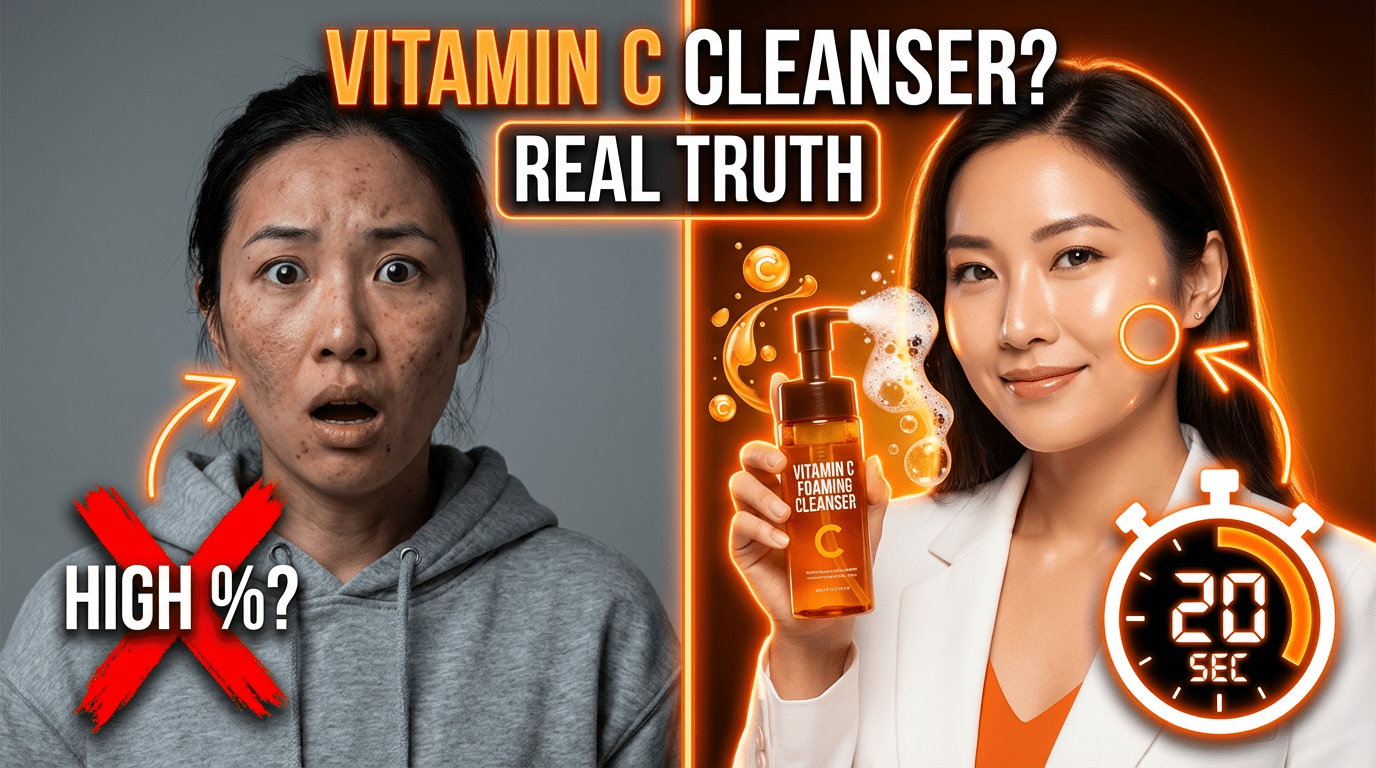
- Don’t get distracted by “high % vitamin C” marketing on wash-off products; for cleansers, surfactant gentleness, barrier support, and irritation risk matter more than chasing potency.
Introduction
You know that end-of-day feeling in Singapore—when your face is a mix of sunscreen, sweat, MRT air, and whatever humidity decided to do to your T-zone? You wash up, look in the mirror, and think: “Why do I still look… dull?” That’s usually when vitamin C enters the chat. And then the next question hits: Do I really need a serum? Because let’s be honest—layering leave-on products can feel sticky, heavy, or just annoying in a hot, humid climate. So here’s what we’re going to do in this guide: set realistic expectations about vitamin C cleanser benefits, explain what rinse-off vitamin C can (and can’t) do, and help you build a simple, non-irritating routine that supports brighter-looking skin—without over-exfoliating, over-cleansing, or falling for hype.
Vitamin C cleansers 101 (quick takeaway for busy Singapore routines)
If you’ve seen “vitamin C cleanser” on a label, it’s tempting to assume it behaves like a vitamin C serum—just in face wash form. But cleansers have one big, non-negotiable feature: they leave your skin quickly. Think of a cleanser as the “get in, do the job, get out” step. That doesn’t make it useless. It just means you should judge it by cleanser standards—comfort, cleanliness, and how your skin behaves after rinsing—rather than expecting serum-level brightening.
What a “vitamin C cleanser” usually contains (L-ascorbic acid vs derivatives)
When people say “vitamin C” in skincare, they often mean
L-ascorbic acid(pure vitamin C). It’s the form most discussed in the research for topical benefits like antioxidant effects and improvement in signs of photoaging and hyperpigmentation—but those outcomes are largely tied to leave-on formulations. (pmc.ncbi.nlm.nih.gov) In cleansers, brands frequently use vitamin C derivatives because they’re generally easier to formulate and can be more stable in real-world products (especially those that contain water). One example is
3-O-ethyl ascorbic acid, a derivative used in Nano Singapore’s Vitamin C Facial Cleanser. (nanosingaporeshop.com) So when you’re scanning labels, “vitamin C” may not mean pure ascorbic acid—and that’s not automatically bad. It’s just a clue that expectations should be “supportive,” not “transformative.”
Why rinse-off products behave differently from serums
Here’s the thing: most of the impressive vitamin C discussions—penetration, dose-response, brightening—are built around contact time. A leave-on serum sits on your skin for hours. A cleanser might get 20–60 seconds (and that’s if you’re not rushing). The science on topical vitamin C’s mechanisms and clinical uses doesn’t automatically translate to a product you rinse off almost immediately. (pmc.ncbi.nlm.nih.gov) That’s why it’s hard to find strong, high-quality clinical studies that specifically prove “vitamin C cleanser fades dark spots” in the same way serums are discussed. The evidence base is simply thinner for rinse-off products. (pmc.ncbi.nlm.nih.gov)
Who this article is for (dullness, uneven tone, first-step brightening, sensitive/acne-prone skin)
This guide is especially for you if:
- You want brighter-looking skin but hate heavy layers in humidity.
- You’re dealing with dullness or mild uneven tone, and you want a gentle entry point.
- Your skin is sensitive, acne-prone, or “maskne”-prone, and you’ve learned the hard way that harsh cleansing backfires.
- You already use sunscreen (or want to start), and you’re building a brightening skincare routine that doesn’t wreck your barrier.
What vitamin C can do for skin (and why cleansers are a different beast)
Vitamin C’s popularity isn’t random. It’s one of the most discussed topical antioxidants in dermatology and cosmetic science because it has plausible mechanisms and clinical use cases—again, mainly in leave-on products. (pmc.ncbi.nlm.nih.gov) Let’s break down what it can do (in general), and then zoom back out to what’s realistic for a cleanser.
Antioxidant support: neutralising oxidative stress (mechanism overview)
Your skin is constantly dealing with oxidative stress—from UV exposure, pollution, and normal metabolism. Vitamin C acts as an antioxidant, helping neutralise reactive species that contribute to visible signs of photoaging over time. (pmc.ncbi.nlm.nih.gov) That antioxidant framing is one reason vitamin C is often positioned as part of a “morning routine.” But it’s also why vitamin C is often paired conceptually with sunscreen—more on that soon.
Brightening and the look of hyperpigmentation/photoaging: what studies mostly show
Topical vitamin C is widely discussed for helping improve the appearance of uneven tone, hyperpigmentation, and photoaging. A key point, though: this conversation is largely built on leave-on formulations where vitamin C can actually sit on the skin long enough to deliver meaningful exposure. (pmc.ncbi.nlm.nih.gov) There’s also evidence that topical delivery can raise vitamin C levels in the skin. For example, one absorption study often cited showed that topical application of 10% L-ascorbic acid increased cutaneous vitamin C levels substantially, with higher concentrations showing a plateau effect. (pubmed.ncbi.nlm.nih.gov) That dose-response detail is useful because it hints at something practical: formulation and contact time matter. A cleanser just doesn’t play in the same arena.
Why most evidence is on leave-on vitamin C (contact time + delivery)
A cleanser’s job is to cleanse—remove oil, sunscreen, grime, and sweat—without leaving you tight, squeaky, or irritated. If it also contains vitamin C (or a derivative), it may provide a “nice-to-have” antioxidant angle. But claiming cleanser vitamin C will deliver serum-like improvements is where things get shaky. Cleansers are rinsed off quickly, and it’s hard to extrapolate leave-on outcomes directly to rinse-off performance. (pmc.ncbi.nlm.nih.gov)
The stability issue: why vitamin C is tricky in real products
Vitamin C (especially L-ascorbic acid) is known to be chemically unstable, particularly in water-based environments, and can degrade with exposure to light and air—plus pH conditions also influence stability and performance. (pmc.ncbi.nlm.nih.gov) A cleanser is commonly water-based and stored in a bathroom (heat, humidity, repeated air exposure). So yes— packaging and formulation choices can make a meaningful difference, and “more vitamin C” on the label isn’t automatically better.
What “nice-to-have” benefits might look like in real life
So what might you notice if a vitamin C cleanser suits you?
- A cleaner, fresher feel after cleansing (without tightness)
- A subtle “glow” that’s really a mix of good cleansing + less congestion
- A routine that feels more “brightening-focused,” which helps you stay consistent
Just keep your expectations calibrated: if you want dramatic changes in stubborn pigmentation, cleanser-only routines typically aren’t the most effective path.
How to choose and use a vitamin C cleanser in Singapore (ingredient + label checklist + step-by-step)
If you’re shopping for a vitamin C cleanser, the smartest approach is to think like a barrier-first minimalist. In Singapore, where humidity can push you toward over-washing (and air-con can dry you out), a cleanser that’s too harsh can quietly sabotage your brightening goals. Let’s talk about what to look for—then exactly how to use it without irritating your skin.
Prioritise gentle surfactants and barrier-friendly formulas (non-stripping first)
Your cleanser is basically a controlled interaction between your skin and surfactants(cleansing agents). If the surfactants are too aggressive—or you use the cleanser too often—you can end up with dryness, rebound oiliness, or that “why is my face stinging?” situation. A practical benchmark: after washing, your skin should feel clean but not squeaky, tight, or itchy. Nano Singapore’s Vitamin C Facial Cleanser lists multiple cleansing/foaming agents such as
Potassium Cocoyl Glycinate, Coco-Glucoside, Lauramidopropyl Betaine, Sodium Lauroamphoacetate, and Cocamide Methyl MEA—a blend typically used to create foam while aiming to stay skin-comfortable. (nanosingaporeshop.com) And if you want a real-world reminder that technique matters as much as product: dermatology advice from a major health system (Henry Ford Health) specifically calls out keeping cleansing simple, using fingertips (no scrubbing), and choosing cool/lukewarm water to avoid stripping oils. (henryford.com)
Vitamin C form matters: L-ascorbic acid vs derivatives in cleansers
For rinse-off products, a vitamin C derivative can be a reasonable choice because it may be more stable in the formulation. Nano Singapore’s cleanser uses
3-O-ethyl ascorbic acid (Vitamin C) in the “brightening & antioxidants” group. (nanosingaporeshop.com) What does that mean in plain English?
- Don’t expect it to behave exactly like a strong low-pH L-ascorbic acid serum.
- Do expect it to function more as part of a supportive, gentle brightening routine, especially if you’re sensitive.
If you’re someone who can’t tolerate leave-on vitamin C (stinging, flushing), a vitamin C cleanser can be a lower-commitment way to explore the category.
Look for supportive ingredients (glycerin, panthenol, etc.)
If you’re chasing brighter-looking skin, irritation is the enemy. Inflammation can make pigmentation look worse and can push you into a cycle of “actives → irritation → more actives.” That’s why I like seeing barrier-supportive ingredients in cleansers, such as:
- Glycerin (hydration support)
- Panthenol (Vitamin B5) (skin comfort)
- Humectants and conditioning agents that reduce the “tight” feeling
Nano Singapore’s cleanser includes
Panthenol, Glycerin, Glycereth-26, Butylene Glycol, and Maltooligosyl Glucoside in its “skin comfort & barrier support” section. (nanosingaporeshop.com) Also worth noting: this product includes
Witch Hazel, which many people associate with an oil-balancing feel—great for some, potentially irritating for others depending on formulation and sensitivity. (nanosingaporeshop.com)
Avoid irritation stacks (strong acids, harsh scrubs, heavy fragrance)
If your cleanser is already doing a “brightening” angle, be careful about stacking multiple high-irritation steps on the same day—especially if you’re also using:
- exfoliating acids (AHA/BHA),
- retinoids,
- physical scrubs,
- or strong fragrance-heavy products.
In Singapore’s climate, people often cleanse more (because sweat). That’s exactly when a “mild product used too often” becomes a problem.
Step-by-step: how to use a vitamin C cleanser safely
If you only change one thing after reading this article, make it technique. 1.
Wet your face with lukewarm water.
Hot water feels relaxing but strips oils more aggressively. (henryford.com) 2.
Use a small amount(pea-sized is usually enough). 3.
Massage gently for ~20–30 seconds.
You’re not sanding a table—you’re lifting off sunscreen, sebum, and debris. 4.
Rinse thoroughly.
Cleanser residue can irritate. 5.
Pat dry (don’t rub) and moisturise. Frequency tips:
- If you’re dry or reactive: start 2–3 times per week.
- If you’re oily/combination and comfortable: consider once daily.
- If you’re breaking out from occlusive sunscreen: night cleansing matters most.
And yes, patch testing is boring—but it’s the boring stuff that saves your face. Introduce one new product at a time so you can actually tell what’s helping (or irritating).
When to stop (normal mild tingling vs red flags)
A mild “clean” sensation is normal. Persistent burning is not. Stop and seek medical advice if you get:
- persistent burning,
- swelling,
- hives,
- blistering,
- or worsening rash.
Also: if you’re dealing with melasma, significant hyperpigmentation, or persistent acne, don’t rely on a cleanser alone. Those conditions often need a more targeted plan with a clinician.
A quick note on “from within” support (supplement quality basics)
This is a skincare article, but readers ask this all the time: Should I take vitamin C or collagen for skin? Dietary supplements can be part of general wellness, but they’re not a shortcut for sunscreen or gentle facial cleansing. If you do decide to buy supplements online, it’s worth being picky:
- Look for brands that are transparent about ingredients and manufacturing standards.
- Check the Supplement Facts panel for meaningful amounts (not “pixie dust” blends).
- Prefer products with third-party testing or clear quality practices where possible.
- Be cautious with mega-doses; more isn’t always better.
For vitamin C specifically, the NIH Office of Dietary Supplements provides detailed guidance on recommended intakes, absorption, and safety considerations. (ods.od.nih.gov) If you’re browsing options, Nano Singapore’s main catalogue is easy to scan by category (including “Skin Health”), which can help you compare formats and labels without impulse-buying. (Here’s the full collection page:
All Products – Nano Singapore.) (nanosingaporeshop.com)
Vitamin C cleanser benefits vs serums and other brightening options (what to pick)
Let’s make the decision practical. You’ve got limited time, limited tolerance for sticky layers, and you want results that are actually noticeable. Before we compare options, one foundational reminder: sunscreen isn’t optional if your goal is brighter-looking, more even-toned skin. UV exposure worsens uneven tone and accelerates visible photoaging; sunscreen helps prevent ongoing damage. (aad.org) Now, here’s a scannable comparison to help you choose.
| Option | Key Benefits | Best For | Notes |
|---|---|---|---|
| Option | Key Benefits | Best For | Notes |
| Gentle non-active cleanser | Removes sweat, oil, sunscreen with minimal irritation | Sensitive, acne-prone, compromised barrier | Often the fastest way to reduce “dull + irritated” look; technique matters (lukewarm water, no scrubbing). (henryford.com) |
| Vitamin C cleanser (rinse-off) | Cleansing + “nice-to-have” antioxidant/brightening support | People who dislike leave-on layers in humidity; low-commitment brightening routine | Results are usually subtle vs leave-on vitamin C; avoid expecting dramatic dark spot fading from cleanser alone. (pmc.ncbi.nlm.nih.gov) |
| Leave-on vitamin C serum | Stronger evidence base for visible brightening/photoaging support | Stubborn uneven tone, early photoaging goals, people who can tolerate actives | Contact time matters; topical delivery studies support increased cutaneous vitamin C with leave-on application. (pubmed.ncbi.nlm.nih.gov) |
| Sunscreen (broad-spectrum, SPF 30+) | Helps prevent worsening of hyperpigmentation and photoaging | Everyone aiming for bright, even-looking skin | Antioxidants complement UV defence but don’t replace sunscreen; reapply on long outdoor days. (aad.org) |
How to interpret this: if your skin is reactive, the “best” brightening plan is often the one you’ll actually stick to— gentle cleansing + moisturiser + sunscreen. Add a vitamin C cleanser when it doesn’t add irritation, and “upgrade” to a leave-on vitamin C only if your skin tolerates it and your goals justify it.
A simple SG routine for brighter-looking skin (AM/PM templates)
If you want a brightening skincare routine that survives Singapore life (humidity, commuting, air-con, and sunscreen), keep it boring—in a good way.
AM (simple and effective)
1. Cleanse (gentle cleanser; vitamin C cleanser is optional) 2. Moisturiser (lightweight is fine) 3. Broad-spectrum sunscreen SPF 30+ (and ideally water-resistant if you sweat) The American Academy of Dermatology emphasises daily sunscreen use when you’ll be outside, plus reapplication about every two hours when outdoors (or after sweating/swimming). (aad.org)
PM (where cleansing matters most)
1. Cleanse to remove sunscreen (consider “double cleansing basics” if you wear heavy sunscreen/makeup: first an oil/balm cleanser or micellar step, then a gentle water-based cleanser) 2. Moisturise 3. Optional targeted leave-on (only if your skin tolerates it) If you want to try Nano Singapore’s cleanser specifically, you can check the ingredient breakdown and cleansing agents on the product page:
Vitamin C Facial Cleanser – 100ml. (nanosingaporeshop.com)
What vitamin C cleansers can’t do (and common marketing traps)
Let’s be very clear on the “can’t,” because this is where expectations go off the rails:
- It won’t replace sunscreen. Antioxidants can complement UV defence, but sunscreen is still the cornerstone for preventing UV-driven pigmentation changes and photoaging. (aad.org)
- It’s unlikely to fade melasma or stubborn dark spots on its own. Those typically need a comprehensive plan (and sometimes prescription options).
- High percentage claims don’t guarantee efficacy in a rinse-off format. Vitamin C’s stability challenges and contact time limitations still apply. (pmc.ncbi.nlm.nih.gov)
- It’s not an acne treatment. If acne is your main issue, you’ll do better with evidence-based acne ingredients and a clinician’s guidance when needed.
When to see a clinician in Singapore (a useful reality check)
Go beyond DIY if you have:
- melasma that keeps returning,
- widespread hyperpigmentation,
- painful or scarring acne,
- or irritation that doesn’t settle despite simplifying your routine.
A good clinician can help you avoid the “product roulette” that drains your wallet and inflames your skin.
Conclusion
If you take one mindset into your routine, make it this: barrier + sunscreen first, actives second. A vitamin C cleanser can be a pleasant, low-commitment add-on—especially in Singapore’s humidity where heavy leave-on layers aren’t always enjoyable—but the results are usually subtle compared with consistent sunscreen and (if tolerated) a leave-on vitamin C. Choose your cleanser for gentleness, use lukewarm water, don’t scrub, and add actives only when your skin is calm enough to handle them. If you’d like a simple place to explore options, you can buy supplements online and build a routine step-by-step without rushing.
Frequently Asked Questions
FAQ 1
Can I use a vitamin C cleanser with retinoids or exfoliating acids?
Usually yes, because it’s rinse-off—but irritation is still possible if your routine is already “active-heavy.” If you’re using retinoids or strong acids, keep your cleanser gentle and avoid stacking multiple irritating steps on the same day.
FAQ 2
Is a vitamin C cleanser okay for acne-prone or “maskne” skin?
It can be. Acne-prone skin often does well with consistent, non-stripping cleansing—especially at night to remove sunscreen. If the formula is too drying or fragranced, though, it may trigger irritation that worsens breakouts.
FAQ 3
How long before I see results—and what counts as a result?
For cleansers, “results” are often about feel: less tightness, cleaner skin, fewer clogged-pore days, and a slightly brighter look after washing. If you’re targeting stubborn dark spots, you’ll likely need sunscreen consistency and a leave-on active, and you should think in weeks to months, not days.
FAQ 4
Does orange colour mean my vitamin C product is oxidised?
Not always—some products are tinted by design or contain botanical extracts. But for many leave-on vitamin C serums, darkening can suggest oxidation. With cleansers, colour alone still isn’t a perfect indicator, but it’s a reason to check storage, expiry, and packaging.
FAQ 5
Do antioxidants replace sunscreen?
No. Antioxidants can support your routine, but sunscreen remains the primary evidence-based protection against UV-related skin changes. If brightening is your goal, sunscreen is non-negotiable.
References
- `https://pmc.ncbi.nlm.nih.gov/articles/PMC5605218/`
- `https://pubmed.ncbi.nlm.nih.gov/16029671/`
- `https://pubmed.ncbi.nlm.nih.gov/11207686/`
- `https://www.aad.org/media/stats/prevention-and-care/sunscreen-faqs`
- `https://ods.od.nih.gov/factsheets/VitaminC-HealthProfessional/`
- `https://www.henryford.com/blog/2019/10/washing-your-face-the-right-way`