Key Takeaways
- The most effective wind-down routines don’t rely on willpower—they rely on timing, light, and cues that nudge your circadian rhythm toward sleep.
- In Singapore, getting a “sleep-friendly bedroom environment” often comes down to cooling + blocking light leaks + managing noise, not buying fancy gadgets.
- Sleep-support gummies (including melatonin) can be a situational tool for sleep timing, but chronic insomnia is best treated with CBT‑I-style strategies and medical evaluation when needed.
Introduction
You know that moment when you finally put your phone down… and suddenly your brain decides it’s the perfect time to replay every awkward thing you said this week? Or you’re exhausted, you crawl into bed early, and somehow you’re still awake at 1:30 a.m.—hot, a bit sticky (thanks, humidity), and annoyed that you’re “doing everything right” but sleep still won’t happen. Here’s the thing: a wind-down routine isn’t meant to knock you out. A good sleep hygiene routine is more like setting up dominoes so your body naturally tips into sleep—less friction, less stimulation, fewer wake-ups. This post walks you through an evidence-based, non-screen wind-down plan that fits real life in Singapore (heat, corridor lights, long work/study hours, noisy neighbours). We’ll also talk about where sleep-support gummies (like melatonin) can fit as an optional aid—and where they really don’t.
Why a wind-down routine matters (beyond “feeling tired”)
Most people start caring about sleep when it starts messing with their day—brain fog, irritability, sugar cravings, or that “I can’t concentrate even though I’m staring directly at my laptop” feeling. But sleep isn’t just recovery in a vague, wellnessy sense. Even short-term sleep deprivation has measurable effects on the body, including impacts on blood pressure, stress hormones, and blood sugar regulation. (It’s one reason consistent sleep is often the unglamorous foundation under mood, metabolism, and training.)
What short-term sleep loss can do to your body
When sleep is cut short or disrupted, your body doesn’t just “feel tired”—it shifts into a more stressed internal state. NIH’s News in Health has discussed how sleep loss can affect systems like cardiovascular function and hormones involved in stress and blood sugar control. That matters if you’re trying to manage energy crashes, cravings, anxiety, or even gym recovery—not just the number of hours you log. In other words: improving your wind-down routine isn’t self-indulgent. It’s a practical health move.
Sleep hygiene vs insomnia: when habits help—and when you need assessment/CBT‑I
A wind-down routine is a sleep hygiene tool. Sleep hygiene is powerful for:
- inconsistent bedtimes,
- late-night device use,
- stress-related “busy brain,”
- environmental issues (heat, light leaks, noise),
- caffeine timing mistakes.
But if you’ve had insomnia symptoms for a long time—especially
3+ months,
3+ nights per week, with noticeable daytime impairment—don’t let your life shrink around sleep. That’s the point where you deserve more than tips. Clinical guidance from NIH (NHLBI) describes cognitive behavioral therapy for insomnia (CBT‑I) as a core, evidence-based treatment approach for persistent insomnia, and it often includes behavioural strategies like stimulus control(we’ll cover that later). Supplements are not a substitute for that kind of targeted treatment. Also: if you suspect sleep apnea—loud snoring, witnessed breathing pauses, or heavy daytime sleepiness—get assessed. Sleep hygiene won’t fix a breathing problem.
The science of winding down: circadian rhythm, melatonin, and evening light
If you’ve ever wondered why you can feel sleepy on the sofa… then wide awake the moment you brush your teeth and climb into bed, the answer often isn’t “weak discipline.” It’s biology: your circadian rhythm plus your evening environment.
Your circadian clock 101: timing vs sleep depth
Your circadian rhythm is your body’s internal 24-hour timing system. It influences sleep-wake patterns and other functions like hormone levels and body temperature. The NIH’s National Institute of General Medical Sciences (NIGMS) describes circadian rhythms as daily cycles driven by a biological clock that responds to day-night cues. This matters because winding down isn’t only about “relaxing.” It’s about telling your clock that night has started. A helpful way to think about it:
- Circadian rhythm = when you feel sleepy or alert (timing)
- Sleep pressure (how long you’ve been awake) = how strongly your body wants sleep (depth/drive)
Your wind-down routine works best when it supports both.
Why bright/blue-enriched light delays sleepiness (melatonin suppression + phase shift)
Melatonin is a hormone your brain produces in response to darkness. NCCIH notes that melatonin helps with the timing of circadian rhythms and sleep, and that light exposure at night can block melatonin production. That’s the heart of the “blue light and sleep” conversation: evening light—especially bright, blue-enriched light—can push your sleepiness later. A PubMed-indexed paper has shown blue light exposure can suppress melatonin and influence circadian timing, which aligns with what many sleep clinicians see in real life: screens + bright lighting close to bed can make it harder to fall asleep. To be clear, it’s not only about the colour of light. Brightness and timing matter too. But practically, most of us aren’t sitting under candlelight at night—we’re under strong overhead LEDs, with a phone 25 cm from our face.
Non-screen takeaway: dim, warm lighting and consistent timing beat willpower
If you do nothing else, do this:
- Pick a “lights-down” time (for many people, 60–90 minutes before bed).
- Shift to warmer, dimmer lighting.
- Keep your bedtime and wake time more consistent than you think you need to.
Because the goal isn’t to fight your brain. It’s to make your environment agree with sleep. And yes—this is especially relevant in Singapore, where late-night work/study hours and device use are common. If your evenings are bright and busy, your circadian system takes that as a cue: “Still daytime.”
Build a Singapore-friendly sleep hygiene routine: environment + a 60-minute non-screen template
Before we get into the step-by-step routine, let’s talk about the boring truth: if your room is hot, bright, and noisy, the “perfect” relaxation technique won’t land the same. This is where Singapore-specific tweaks really matter.
Set up your sleep-friendly bedroom environment (cool, dark, quiet)
Temperature: cooling strategies that work in humid weather
A cooler-feeling room tends to be more sleep-promoting for many people. In Singapore’s heat and humidity, that often means:
- Use AC strategically, not heroically. Cool the room before bed, then adjust so you don’t wake up freezing at 4 a.m.
- If you use a fan, aim it to circulate air across the room, not blast your face all night (dry eyes + stiff neck is a real combo).
- Try a warm shower 30–60 minutes before bed, then let your body cool down after. The contrast can support the “it’s night now” cue.
Also, don’t underestimate humidity. If you’re waking up sticky, it fragments sleep even if you don’t fully remember it.
Bedding and clothing: breathable fabrics and sweat management
This is the part nobody wants to think about, but it works:
- Choose breathable sheets (many people do well with cotton, bamboo blends, or linen).
- Consider lighter sleepwear that manages sweat rather than trapping it.
- If you’re a “blanket person,” swap heavy blankets for a lighter layer so you still get that cosy pressure without overheating.
Small reductions in discomfort can reduce micro-awakenings—the tiny wake-ups that make sleep feel shallow.
Light control in HDB/condo settings: corridor light leaks and the “tiny glow” problem
Light leaks are sneaky. Common sources:
- corridor light through the door gap,
- LED clock displays,
- phone charging lights,
- street lamps through sheer curtains.
Quick fixes:
- Blackout curtains (or at least thicker curtains) can help.
- A simple door draft stopper can block corridor light.
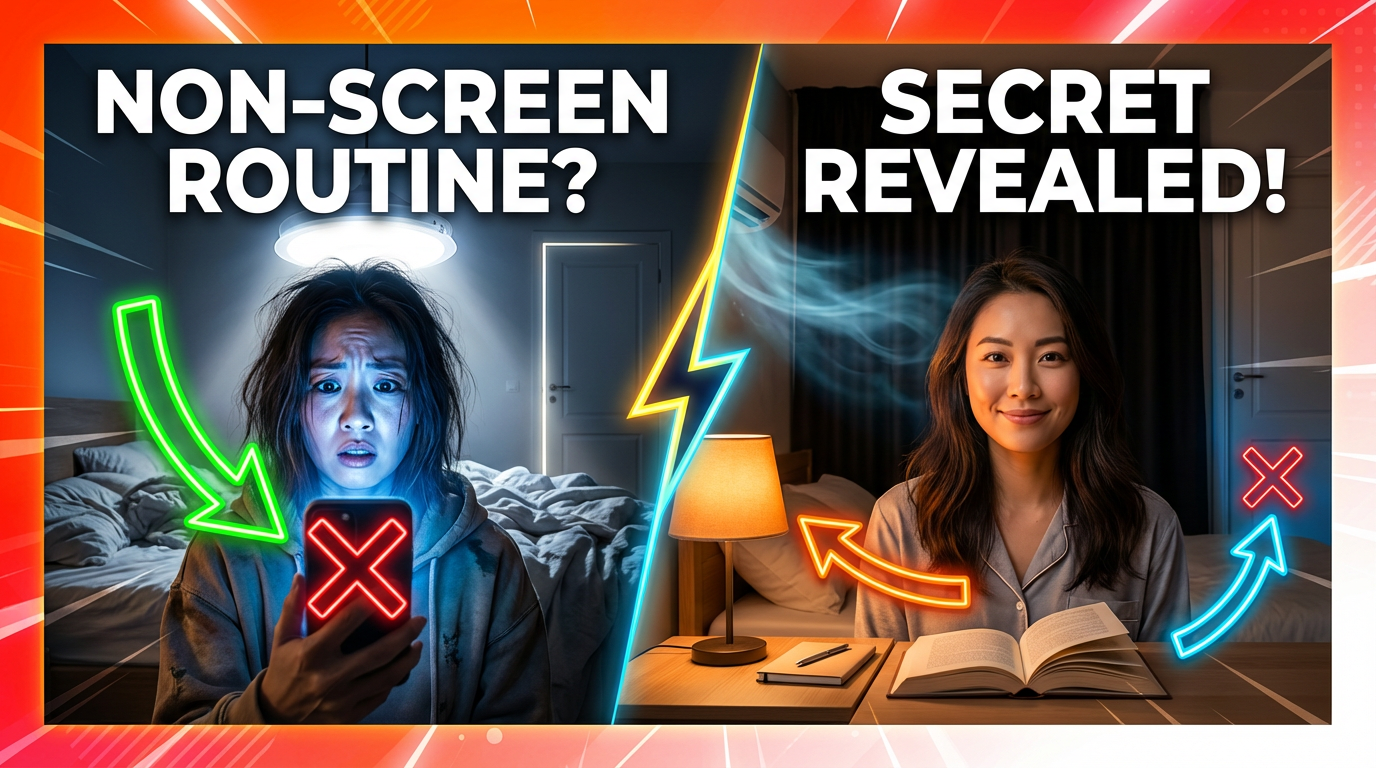
- Use a warm, dim bedside lamp instead of overhead lighting in the last hour.
Remember: your brain’s melatonin system responds to light. Darkness is part of the routine, not just the absence of a screen.
Noise strategies: traffic/neighbours, white noise vs earplugs
Singapore living can be noisy—traffic, neighbours, renovation schedules. Options:
- Earplugs can work if you tolerate them (choose comfortable ones; don’t force it).
- Steady background noise (like a fan) sometimes helps by smoothing out sudden sound changes.
- If noise is predictable, plan your wind-down so you’re already sleepy before the louder periods hit.
A quick comparison: what actually helps during wind-down?
A lot of “natural sleep aids” talk online mashes everything together. The better question is: what problem are you trying to solve—timing, stress, environment, or a conditioned habit like doomscrolling in bed?
| Option | What it supports | Best for | Notes |
|---|---|---|---|
| Option | What it supports | Best for | Notes |
| Dim, warm lighting + no screens | Circadian timing (melatonin-friendly signal) | Late-night scrollers, night owls | Consistency matters more than perfection; start 60–90 minutes before bed |
| Cool, breathable bedroom setup | Comfort + fewer wake-ups | Hot sleepers in humid climates | Optimise airflow, bedding, and light leaks; don’t overheat under heavy blankets |
| Relaxation techniques before bed (breathing/PMR) | Lower physiological arousal | Stress, rumination, “wired but tired” | Works best as a practice, not a one-off rescue on the worst night |
| Melatonin gummies (optional) | Sleep timing (circadian-related) | Jet lag, shifted schedules, delayed sleep phase | Not a cure for chronic insomnia; check interactions and avoid alcohol/sedatives |
Use this table like a sorting hat: light and routine are your foundation, environment removes friction, relaxation lowers arousal, and supplements(if you use them) are situational tools—not the main event.
Your 60-minute wind-down routine (non-screen) — a step-by-step template
Let’s build a routine that’s realistic on a weeknight and doesn’t require an app.
T–60 to T–45: “Close the day” ritual (reduce rumination)
This is for the people whose brains start planning tomorrow at midnight. Try a 5–10 minute “close the day” ritual:
- Brain dump: write every looping thought (“email Sarah,” “mum’s appointment,” “that comment in the meeting…”).
- Next-day plan: pick 1–3 priorities for tomorrow, plus any “must not forget” items.
The point isn’t productivity. It’s giving your brain permission to stop scanning for threats and loose ends. Tip: keep the notebook and pen in a fixed spot. When it’s always there, your brain learns: “We handle worries here, not in bed.”
T–45 to T–30: warm shower or wash-up + change cues
Sleep is heavily cue-driven. Create a consistent sequence:
- shower / wash face,
- skincare (if you do it),
- change into sleepwear,
- prep room (fan/AC, curtains, water).
These are “transition cues.” Over time, they become a learned signal that bedtime is inevitable (in a good way).
T–30 to T–15: relaxation that works without apps
Pick one and repeat it nightly for two weeks before you judge it:
- Box breathing (slow, gentle): inhale → hold → exhale → hold, each for a comfortable count.
- Progressive muscle relaxation (PMR): tense and release muscle groups from feet to face.
- Gentle stretches: think “unwinding,” not “workout.”
If your mind wanders, that’s normal. Just come back to the body. You’re training attention, not chasing a perfect calm.
T–15 to lights out: low-stimulation activities
Choose something that doesn’t pull you into “one more thing” mode:
- paper book,
- light journaling (gratitude, a few lines),
- calm music at low volume.
If you must do something on a device, keep it brief and make it as boring as possible (but ideally, keep this routine truly non-screen).
If you share a room: coordinate without conflict
Shared rooms are common—partners, kids, multigenerational households. A few peacekeeping options:
- agree on a lights-down time,
- use a small warm reading light on one side,
- consider an eye mask if you tolerate it,
- negotiate “quiet tasks” vs “noisy tasks” (folding laundry is quieter than hair-drying).
The goal isn’t a perfect routine—it’s reducing nightly friction.
What to do when sleep still doesn’t happen: stimulus control, daytime anchors, and optional aids
A wind-down routine gets you sleepy.
Stimulus control helps you stay asleep (and stops the bed from becoming a frustration zone).
Stimulus control (CBT‑I principle): make your bed a strong sleep cue
NHLBI’s insomnia treatment guidance includes behavioural approaches used in CBT‑I, and stimulus control is one of the most practical: strengthen the association between your bed and sleep, and reduce time awake in bed.
Use the bed mainly for sleep and sex—so what do you do if you’re wide awake?
If you’re awake and restless, the instinct is to stay in bed and “try harder.” Unfortunately, that can train your brain to associate bed with alertness. Instead, keep a simple backup plan:
- Sit in a dim corner (or living room) with low light.
- Do something calm: light reading, gentle stretching, boring magazine.
- Return to bed only when you feel sleepy again.
It’s not about punishment. It’s about protecting the bed as a cue for sleep.
The “20-minute rule” (without obsessing over the clock)
People often describe a “get out of bed if you can’t sleep after ~20 minutes” idea. You don’t have to time it perfectly—just notice the shift:
- If you’re dozing, stay put.
- If you’re alert, frustrated, or mentally scrolling, get up briefly.
Keep lights dim. Avoid screens. You’re trying to lower stimulation, not start a second day.
Middle-of-the-night awakenings without reaching for your phone
This is where most routines collapse—because nighttime wake-ups feel boring and lonely. Try this:
- Don’t check the time if it spikes your anxiety.
- Keep a paperback or note pad nearby.
- If thoughts start racing, write them down in a few lines, then stop.
If you grab your phone, your brain gets two powerful rewards: light + novelty. And it learns to ask for that again at 3 a.m.
Daytime habits that make nights easier (without turning life into a checklist)
Morning light + a regular wake time: the anchor habit
If your sleep schedule is messy, start with wake time, not bedtime. A consistent wake time anchors circadian rhythm (your body clock responds strongly to time cues). Morning light exposure—natural daylight if possible—is a strong “daytime signal.” If you’re sleeping in wildly different hours on weekends, it can feel like mini jet lag every Monday.
Caffeine and sleep: a practical cut-off for Singapore schedules
Caffeine timing is personal, but many people do better when they set a caffeine boundary:
- Keep coffee/tea earlier in the day.
- Be cautious with late afternoon kopi, bubble tea, or pre-workout.
If you’re struggling to fall asleep, experiment with a stricter cut-off for two weeks and see if sleep onset improves.
Exercise timing: what if late workouts are your only option?
Ideally, intense workouts end earlier. But real life is real life. If evenings are your only slot:
- keep the last 10 minutes truly cooling down,
- do a warm shower after,
- avoid turning your post-workout period into a second work shift (bright lights + emails + high-energy music).
You’re trying to transition from “performance mode” to “recovery mode.”
Meals and alcohol: why alcohol can backfire
A heavy late supper can trigger discomfort or reflux for some people. Alcohol might make you feel sleepy initially, but it can fragment sleep quality later in the night. If you notice 3 a.m. wake-ups after drinks, that’s useful data—not a moral failing.
Optional aids: where sleep-support gummies (melatonin) fit—and where they don’t
Let’s talk about gummies carefully, because the internet is noisy here.
Melatonin basics: a timing hormone, not a knockout sedative
NCCIH is clear: melatonin is a hormone produced in response to darkness that helps regulate circadian timing, and light at night can block melatonin production. That framing matters, because it explains why melatonin tends to help best with sleep timing issues.
Best-fit scenarios: jet lag, shifting schedules, delayed sleep-wake phase
NCCIH notes melatonin supplements may help with conditions like jet lag and delayed sleep-wake phase disorder, though evidence varies by condition and outcome. These are circadian-related problems—your sleep is “mis-timed,” not necessarily broken. So if you:
- just flew across time zones,
- are switching shifts,
- consistently can’t get sleepy until very late despite being tired,
…melatonin may be worth discussing with a pharmacist or clinician as part of a broader plan (light, timing, routine).
How to use thoughtfully: low-and-slow, short-term trials, and label literacy
If you decide to try sleep-support gummies, think like a careful consumer: 1)
Start with the lowest effective approach
More isn’t automatically better, and next-day drowsiness is a real risk for some people. 2)
Treat it as a short-term experiment
Try a consistent routine for 1–2 weeks and track:
- sleep onset time,
- number of awakenings,
- next-day alertness.
3)
Read labels like a grown-up
Look for:
- clear ingredient listing,
- dosage per serving,
- instructions for timing,
- manufacturer quality signals (e.g., GMP).
As an example of a sleep-support formulation, Nano Singapore’s

If you’re the kind of person who likes to browse and compare labels across brands, you can also buy supplements online and use the ingredient lists as a practical education in what’s actually inside different formulations.
Safety checklist (please don’t skip this)
Use the conservative rules:
- Don’t combine melatonin (or other sleep aids) with alcohol or sedatives unless a clinician tells you to.
- Melatonin can cause daytime drowsiness, headache, dizziness, and it can interact with medicines. NCCIH specifically flags caution for people taking certain medicines (including blood thinners) and those with epilepsy, and notes limited safety data in pregnancy/breastfeeding.
- Don’t drive or operate machinery if you feel drowsy the next day.
- Keep gummies away from children—flavoured supplements are easy to accidentally overconsume.
And if insomnia is persistent (≥3 months, ≥3 nights/week, daytime impairment), consider CBT‑I and medical evaluation rather than stacking products.
Troubleshooting: if your wind-down routine isn’t working yet
If you’ve tried this for three nights and you’re ready to declare yourself “a bad sleeper,” pause. Sleep systems usually change more slowly than motivation. Try this troubleshooting order: 1)
Give it 2 weeks, tracking a few simple metrics
- “lights-down” time
- estimated sleep onset
- awakenings
- morning energy (1–10)
2)
Adjust one input at a time
Most common high-impact tweaks:
- dim lights earlier,
- cooler room,
- consistent wake time,
- caffeine cut-off.
3)
Look for red flags
- loud snoring / breathing pauses,
- restless legs symptoms,
- panic symptoms at bedtime,
- insomnia persisting for months.
At that point, help is a strength move, not a last resort.
Quick-start plans you can copy tonight
If you want something you can actually do after a long day, pick one of these.
The 15-minute “minimum viable” wind-down
- Dim lights.
- Wash up.
- 3 minutes of slow breathing.
- Get into bed with a paper book for a few pages, then lights out.
The 30-minute standard routine (most people)
- 5-minute brain dump + tomorrow plan.
- Warm shower / wash-up.
- 5–10 minutes of PMR or gentle stretching.
- Paper book or journaling under warm light, then lights out.
The 60-minute deep wind-down (high stress, frequent awakenings)
- T–60: close-the-day ritual + set room (cool, dark, quiet).
- T–45: shower + change cues.
- T–30: breathing/PMR + stretch.
- T–15: low-stimulation activity + lights out.
- If awake: stimulus control (get up briefly, dim light, no screens).
Before-dinner bedroom prep checklist (so bedtime is easier)
- Set AC/fan plan and put water by bedside.
- Put your phone charger outside the bedroom (or across the room).
- Place book + notebook + pen where you can reach them.
- Close curtains, block light leaks, set warm lamp.
Conclusion
A deeper sleep routine usually isn’t about adding more hacks—it’s about removing friction and giving your body the cues it already understands: dim light, cooler comfort, quieter input, and a consistent rhythm. If you build just three pillars— a lights-down window, a cooler/darker room, and a repeatable non-screen wind-down—you’ll be surprised how often sleep starts showing up more reliably. And if sleep still feels like a nightly battle after a few weeks, that’s a sign to explore CBT‑I-style support rather than blaming yourself. If you’d like to compare formulations and learn how to read labels more confidently, here’s a helpful place to start: buy supplements online
Frequently Asked Questions
FAQ 1
How long before bed should I stop using screens?
Many people do well with a
60–90 minute buffer. The key is consistency: pick a realistic cut-off time you can repeat most nights, and pair it with dim, warm lighting so your body actually gets a “night signal.”
FAQ 2
If I wake up at 3 a.m., should I stay in bed or get up?
If you’re calm and drowsy, stay in bed. If you’re alert, frustrated, or tempted to scroll, it often helps to get up briefly and do a quiet, dim-light activity, then return to bed when sleepy (a stimulus control approach used in CBT‑I).
FAQ 3
Does a warm shower help sleep, or does it wake you up?
For many people, a warm shower
30–60 minutes before bed helps because the post-shower cooling phase can feel sleepier. If you notice it energises you, shorten it, lower the water temperature slightly, or move it earlier.
FAQ 4
Are melatonin gummies safe to take every night?
Melatonin is widely used, but “safe for everyone, nightly, long-term” is too strong a claim. NCCIH notes short-term use appears safe for many adults, but long-term safety data is limited, and interactions are possible. If you’re considering frequent use, especially with medical conditions or medications, check with a pharmacist or clinician.
FAQ 5
What’s the biggest mistake people make with a wind-down routine?
Trying to do the routine perfectly—then giving up after a bad night. Sleep is variable. Aim for a routine you can repeat even on stressful days, and give it two weeks before you evaluate whether it’s helping.
References
- https://www.nigms.nih.gov/education/Pages/Circadian-Rhythms
- https://www.nhlbi.nih.gov/health/insomnia/treatment
- https://www.nccih.nih.gov/health/melatonin-what-you-need-to-know
- https://newsinhealth.nih.gov/2013/04/sleep-it
- https://pubmed.ncbi.nlm.nih.gov/25506253/
- https://health.clevelandclinic.org/sleep-hygiene
- https://www.mayoclinic.org/healthy-lifestyle/adult-health/multimedia/sleep-tips/vid-20452641