
Key Takeaways
- The real reason supplements get skipped is friction (too many bottles, too many “times”), not a lack of willpower—so your job is to make taking them the easiest part of your day.
- The safest organisation “hack” is simplification: remove duplicates, watch for stacking (multivitamin + single nutrients + fortified foods), and write a one-page plan before you start sorting pills.
- Consistency improves when you reduce the number of daily “pill events” and anchor supplements to cues that already happen (coffee, brushing teeth, leaving home), with storage that works in Singapore’s humidity.
Introduction
You know the moment. You’re halfway out the door, EZ-Link card in hand, and you remember the supplements you meant to take… sitting somewhere on a shelf behind the rice cooker. Or you notice it at 11:47pm—right when you’re finally in bed—because the bottles are staring at you from the dresser like a guilt trip. If that sounds familiar, you’re not alone. And more importantly: it doesn’t mean you’re “bad at routines.” Taking supplements consistently is a tiny behaviour that gets crushed by tiny obstacles—searching for bottles, wondering “with food or without?”, second-guessing whether you already took them, travelling, late shifts, humidity turning a cabinet into a sauna… all the stuff that makes daily life feel full. This guide is all about practical, evidence-informed supplement organisation tips you can actually live with in Singapore: how to simplify safely, set up a system (pill box, original packaging, blister packs), link supplements to cues like kopi/breakfast or brushing teeth, and build reminders that don’t get ignored. I’ll also show you how to read labels and evaluate quality, because “organised” isn’t helpful if it leads to accidental double-dosing.
Why you keep missing supplements (and why it’s not a “willpower” problem)
Let’s be honest: most people don’t skip supplements because they don’t care. They skip because the routine is high-friction.
Decision fatigue: too many bottles, too many times
Every separate bottle is a mini decision:
- Where is it?
- How many do I take?
- Is this the one that upsets my stomach if I don’t eat?
- Did I already take it today?
When your brain has to negotiate with your supplement shelf every morning, you’re basically relying on motivation. Motivation is… unreliable. Systems are kinder.
Friction points in Singapore life: early calls, shift work, commuting, irregular meals
Singapore routines can be surprisingly “unroutine.”
- If you work shifts (healthcare, security, aviation, logistics), your “morning” might start at 6pm.
- If you commute, the “I’ll do it when I get to the office” plan often dies somewhere between the MRT platform and the first meeting.
- If your meals are irregular—quick kopi, then lunch is a hawker dabao at 3pm—anchoring supplements to meals can backfire.
So the goal is to anchor supplements to something that happens even when everything else changes.
The adherence insight: fewer daily “pill events” tends to improve consistency
There’s a useful behavioural insight from medication adherence research: the more times per day you have to take something, the more likely you are to miss doses. Reviews and meta-analyses have found that less frequent dosing schedules are generally associated with better adherence than multiple daily doses. Now, supplements aren’t prescription meds, and you shouldn’t change dosing just to make it “tidier.” But the principle is still helpful: > If your supplement routine requires four separate moments per day, you’ve built a system that’s fragile. So what does that mean in real life? It means your organisation strategy should aim for:
- fewer daily dosing moments (when appropriate),
- clearer rules (written down),
- a setup that makes “did I take it?” obvious in two seconds.
Step 1 & 2: Simplify the regimen first—then make a 2-minute “Master Supplement Map”
If you only do one thing from this whole article, do this: simplify before you organise.
A perfectly organised cabinet can still be a perfectly organised mess.
Do you even need all of these? (When “less” is safer)
A lot of people accidentally build a supplement routine the way they build a streaming watchlist: hopeful, impulsive, and slightly chaotic. Major medical sources regularly point out that supplements aren’t universally needed, and a food-first approach is preferred for many nutrients. The risk of “just in case” supplementing is that it can:
- increase the chance of unnecessary side effects (like GI upset),
- increase interaction risk (especially if you take medications),
- and create routine fatigue (which lowers consistency anyway).
In practice, simplifying often looks like:
- keeping the one or two supplements that match a real gap (dietary pattern, labs, clinician advice),
- stopping “duplicate benefits” products (three different “hair skin nails” items),
- and removing anything you bought once, didn’t notice a benefit from, and kept out of guilt.
List everything you take (yes, everything)
Make a quick inventory. Include:
- multivitamins
- single nutrients (vitamin D, magnesium, zinc, iron, etc.)
- fish oil/omega-3
- probiotics
- herbal products
- collagen powders
- “beauty” gummies
- fortified drinks (some contain added vitamins/minerals)
This is also where you catch the sneaky stuff: a “wellness tea” that’s basically an herbal supplement; gummies that look harmless but add up.
Check duplicates and “stacking” risk
Stacking is when you unintentionally pile the same nutrient from multiple sources:
- a multivitamin
+ a “bone health” product + an immune formula + fortified cereal or drinks = a surprisingly high total. This matters because many vitamins and minerals have
Tolerable Upper Intake Levels (ULs)—levels above which the risk of adverse effects increases for some people. A practical way to stay grounded (instead of trusting random internet schedules) is to cross-check evidence-based resources like the NIH Office of Dietary Supplements fact sheets, which summarise typical uses, safety, upper limits, and known cautions for many nutrients and ingredients.
When to consult a pharmacist/doctor (don’t skip this if it applies)
Organisation tips support adherence, but they don’t substitute for medical guidance—especially if:
- you’re pregnant/breastfeeding,
- you have chronic conditions (kidney disease, thyroid conditions, liver disease, diabetes),
- you take blood thinners/antiplatelets (bleeding risk can apply to certain supplements),
- you’re preparing for surgery,
- you’re taking iron, iodine, vitamin A, or high-dose single nutrients,
- you’ve had allergic reactions or severe GI issues after starting a supplement.
If you’re supporting an older adult in a multigenerational household, it’s also worth getting a pharmacist to review the full list—because mix-ups are more common when multiple people are sharing storage space.
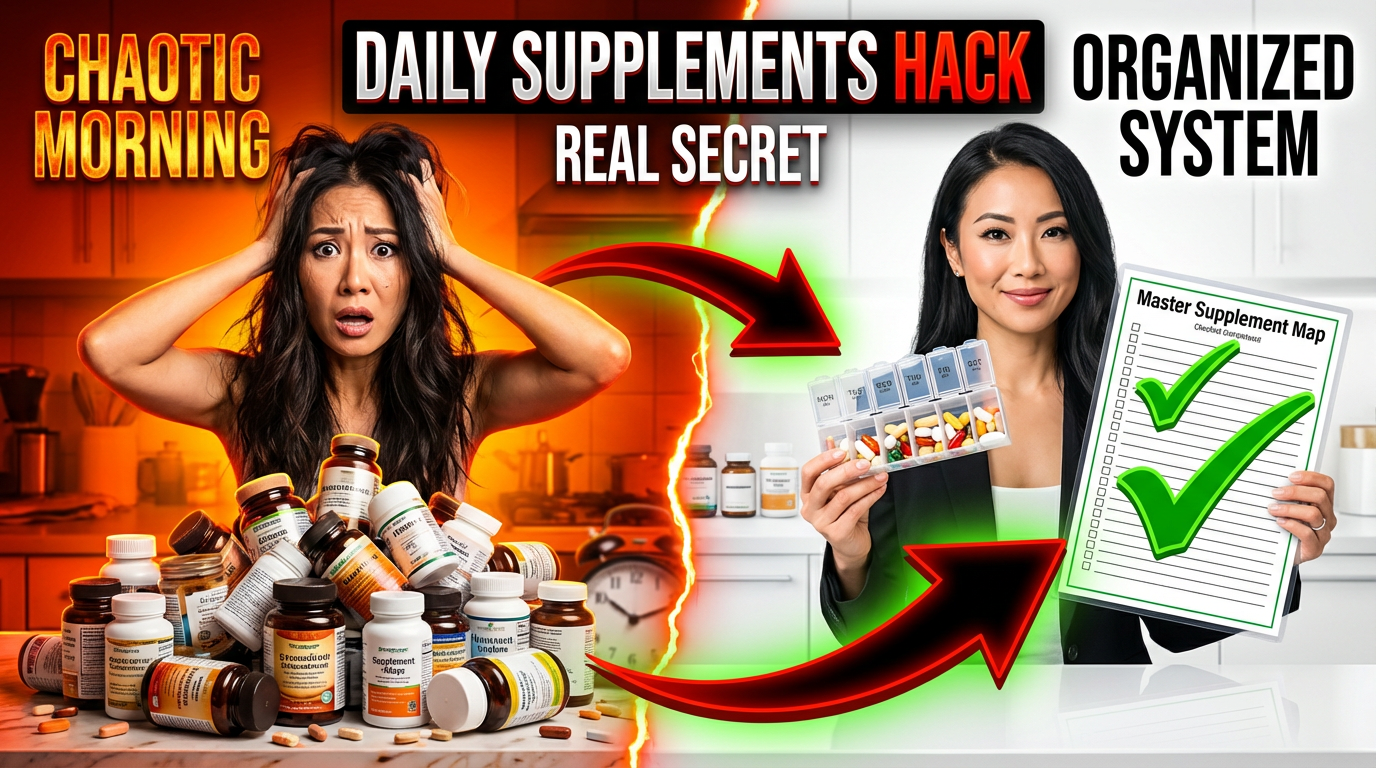
Build your 2-minute “Master Supplement Map” (one page that prevents mistakes)
Once you’ve simplified, make your plan visible. You can do this on:
- one sheet of paper on the inside of a cabinet door,
- a notes app,
- or a printed template.
Write (in large, boringly clear text): 1.
Product name(and what it looks like—colour/shape helps) 2.
Active ingredients(especially important for blends) 3.
Dose(e.g., 1 capsule) 4.
Time anchor(e.g., “after breakfast kopi”) 5.
Food note(“with food if nauseated” / “follow label”) 6.
Interaction flags(“check with pharmacist if on blood thinners”) 7.
Upper limit caution(especially if it’s a high-dose single nutrient) 8.
Start/stop date or review date (e.g., “review at 8–12 weeks”) 9.
Refill date(so you don’t run out and lose momentum) A surprisingly good tool here is the NIH’s “My Dietary Supplement and Medicine Record” PDF, which is basically a structured version of this idea. It’s caregiver-friendly and prompts the right safety questions.
Make it caregiver-friendly (Singapore reality check)
If you’re doing this for parents or grandparents:
- use big font
- consider writing key notes in the language they’ll actually read fastest (Mandarin/Tamil/Malay/English mix is totally fine)
- add one rule at the top: “If unsure, skip and ask.” That sounds conservative, but it prevents accidental double-dosing.
Step 3: Choose your organisation system (pill box vs original packaging vs blister packs)
Once you’ve simplified and mapped things out, then you pick the container system. The best system is the one that reduces mistakes and fits your actual week. Here’s a quick comparison to make the decision easier.
| Option | Key benefits | Best for | Notes / watch-outs |
|---|---|---|---|
| Option | Key benefits | Best for | Notes / watch-outs |
| Weekly pill organiser (pill box usage) | Fast, visible “did I take it?” check; reduces daily bottle-handling | People taking several capsules daily; busy commuters; anyone who forgets if they’ve taken a dose | Fill carefully in good lighting; keep dry; don’t decant items if the label warns against moisture/light exposure |
| Original bottles/packaging | Best stability and identification; keeps lot/expiry info together | Moisture- or light-sensitive products; people who take only 1–2 items | Slightly more daily friction; consider placing bottles in one tray so they move as a unit |
| Pharmacy blister packs | Low mix-up risk; very clear dosing schedule; caregiver-friendly | Older adults, complex routines, polypharmacy (supplements + multiple meds) | Ask about storage in heat/humidity; keep an updated list so changes don’t cause confusion |
| Daily mini-case + backup dose | Portable; supports shift work and travel-friendly supplement storage | Shift workers; frequent travellers; people who often eat away from home | Keep a labelled “backup” dose separate to avoid double-dosing; don’t store loose pills in wallets/pockets |
| Non-pill system (sachets/powders/liquids) | Harder to forget if integrated into a drink/meal routine | Collagen powders, electrolyte sachets, liquids | Pre-portion where possible; check whether refrigeration is needed; keep measuring scoops consistent |
Read the table like a matching exercise: you’re not looking for the “best” option— you’re looking for the least error-prone option for your life.
If you live with kids, for example, child-safe storage might matter more than convenience. If you travel weekly, portability might matter more than aesthetics.
Option A: Weekly pill organiser (classic for a reason)
A weekly pill organiser works because it removes two daily pain points: 1) hunting for bottles, and 2) the “did I already take it?” spiral. In Singapore, they’re easy to find at Guardian/Watsons and online marketplaces. Some people also like using a slightly nicer one—because if it feels pleasant to use, you’re more likely to stick with it. For instance, Nano Singapore has a limited-edition pill organiser called the
Milo & Kaya Pill Box. The point isn’t that you need a fancy box—it’s that a dedicated, easy-to-spot container can cut decision fatigue dramatically.
Filling best practice (to avoid mistakes):
- do it once weekly (same day/time)
- one bottle at a time (finish that bottle, then move to the next)
- good lighting
- double-check the map, not your memory
Option B: Keep in original packaging (sometimes the “boring” choice is the smart one)
Some supplements are more sensitive to moisture/light. If a label says not to remove desiccants, or to keep tightly closed, respect that. Singapore humidity is no joke, and bathrooms are basically humidity machines. A compromise that works well:
- keep everything in original bottles,
- but store the bottles together in a single tray or container,
- and put that tray where your anchor cue happens (coffee station, dining table cabinet, etc.).
Option C: Blister packing (especially helpful for caregivers)
If you’re caring for someone (or managing your own meds + supplements), blister packs reduce mix-ups because they:
- create a fixed schedule,
- reduce the “grab the wrong bottle” risk,
- and make missed doses obvious.
It’s also psychologically easier: you don’t have to decide anything. You just follow the pack.
Travel/shift-work option: a daily mini-case + a “backup dose” strategy
If you do long shifts or you’re constantly out, a weekly organiser at home might not be enough. Try this:
- keep your main supply at home,
- pack a small labelled mini-case for the day,
- keep a backup dose at work (in a safe, dry place) only if you can do it without confusing yourself.
Important: backup dosing is where double-dosing happens. If you’re prone to “not sure if I took it,” you need a confirmation method (more on that below).
Non-pill supplements: powders, liquids, sachets—how to “organise” them too
Powders and sachets can actually be easier to remember—if you attach them to an existing routine. Examples:
- collagen powder goes beside your coffee/tea canister (not hidden with the baking supplies)
- a sachet supplement goes inside your work bag next to your access card, so you see it during your commute
- liquids that require refrigeration get a dedicated fridge spot with a sticky note cue
This is also where supplement form matters:
- capsules/tablets: easiest to store and track
- gummies: easy to take, but easy to over-treat like candy (watch dosing)
- powders: good for people who dislike pills, but requires a consistent mixing habit
If you’re the type who hates swallowing pills, changing form can be the difference between “perfect plan” and “actually happens.”
Step 4–8: Make it automatic—anchor routines, fewer “pill events,” reminders, and safe storage
This is the part that turns good intentions into a daily supplement routine that survives real life.
Step 4: Pick 1–2 fixed cues (plus a Plan B)
Anchors are cues that already happen. You’re not trying to “find time” for supplements—you’re trying to attach them to something you already do. Good anchors are:
- stable (happens almost every day),
- specific (not “sometime in the morning”),
- and physically linked to your supplements.
Cue ideas that work well in Singapore:
- your first kopi/coffee/tea
- brushing teeth (morning or night)
- skincare step (moisturiser = “supplements then moisturiser”)
- the moment you check your bag before leaving home
- your MRT “tap-in” moment (use as the reminder cue, not the swallowing moment)
- end-of-shift meal (for shift workers)
Now the crucial part:
Plan B.
If your anchor is breakfast, what happens on the days you skip breakfast? Plan B cues could be:
- “first drink of the day” (even if it’s just water)
- “when I sit down at my desk”
- “after I brush my teeth at night” (if the supplement label allows)
Your Master Supplement Map should state the Plan B in one sentence:
- “If no breakfast: take after lunch.”
- “If missed by 3pm: skip and resume tomorrow.” (Only if that’s appropriate per label/clinician advice.)
Pairing with food: follow label/clinician advice, not internet schedules
One of the fastest ways to break consistency is trying to follow a complicated online timetable:
- “This one at 6:12am on an empty stomach…”
- “That one exactly 2 hours away from minerals…”
- “Never together with anything…”
Here’s the more realistic approach: 1.
Start with the product label.
2. If you have conditions/medications, confirm with a pharmacist/doctor. 3. Adjust based on tolerability (e.g., nausea on an empty stomach). Evidence-based resources like NIH ODS fact sheets are useful when you’re checking upper limits, typical dosing ranges, and cautions—especially for single-nutrient supplements.
Step 5: Reduce the number of daily dosing moments (when appropriate)
If you take supplements 3–4 times per day, you’re running a high-maintenance system. Reviews of dosing frequency and adherence (in medication contexts) repeatedly show that fewer dosing times per day is generally linked with better adherence. So, without changing what you take (and without ignoring label instructions), ask:
Can I turn 4 micro-doses into 1–2 “pill events”?
Practical examples:
- Morning-only stack: items that are fine with your breakfast/coffee cue
- Dinner-only stack: items that feel better with a full meal
- Split only when required: if something genuinely needs spacing for tolerability or instructions, split it—but keep it to the minimum number of splits
When not to consolidate
- the label says otherwise
- you get GI upset taking multiple capsules at once
- you’re on clinician-directed timing (e.g., iron timing considerations)
- you’re managing an interaction risk and have been told to space things out
Consistency is great. Safety is non-negotiable.
Step 6: Reminders that don’t get ignored
A reminder only works if it’s:
- timely,
- specific,
- and paired with an action you can do right then.
Start low-tech:
- put your pill organiser on the coffee station (visual cue beats willpower)
- tape a tiny checklist inside a cabinet door
- use a rubber band on your mug handle as a “haven’t taken it” marker (remove it after)
Scale up to phone-based reminders:
- alarms titled “Supplements: take now + close lid” (the “close lid” part matters because it prompts confirmation)
- calendar blocks (5 minutes, recurring)
- medication reminder features (iOS/Android options vary, but even a basic recurring alarm works)
For seniors and caregivers:
- a simple WhatsApp check-in can be surprisingly effective, especially if it’s consistent and non-judgy (“Did you take the blue capsule after lunch?”).
Step 7: Safety and storage in Singapore’s humidity (and with kids/pets)
Organisation can accidentally create risk if you’re not careful.
Humidity & heat rules
- avoid storing supplements in bathrooms (steam + heat)
- keep them in a cool, dry cabinet away from the stove
- if the bottle comes with a desiccant, keep it in the bottle
- close lids properly (half-closed caps are basically humidity invitations)
When NOT to decant into pill boxes
- if the label warns against exposure to moisture/light
- if tablets are clearly reactive (softening, sticking, smell changes)
- if you need the original packaging for identification (important in mixed households)
Child/pet safety
- store out of reach, ideally in a higher cabinet
- consider child-resistant storage if there are young kids at home
- never describe supplements as “candy” (especially gummies)
If you miss a dose
- follow label or clinician advice
- avoid double-dosing unless explicitly directed
And if you develop allergic symptoms, severe GI upset, or anything concerning after starting a supplement, stop and seek medical advice.
Step 8: Make it sustainable—weekly reset, restocking, and quick tracking
The routine that lasts is the one that includes maintenance.
Pick a weekly reset time
Sunday night works well for many people because it’s a natural “reset” moment. But any consistent slot is fine:
- after grocery shopping
- after laundry
- payday (for refill checks)
A simple restocking workflow
- set a reorder threshold (e.g., “when 2 weeks left”)
- check expiry dates during reset
- keep one list of what you’re taking so you don’t “accidentally re-add” old supplements
If you prefer convenience, many people in Singapore choose to buy supplements online and schedule refills—just make sure you’re still reviewing what you take every couple of months instead of letting auto-ship decide your health routine.
Common scenarios (Singapore editions): plug-and-play setups
1) Shift workers (healthcare, security, aviation)
- Anchor A: end-of-shift meal
- Anchor B: brushing teeth before sleep
- Tool: daily mini-case in work bag + weekly organiser at home
- Reminder: one alarm timed to your shift schedule (not “9am”)
2) Office workers
- Anchor A: kopi/coffee at home
- Plan B: after lunch (set one quiet phone reminder)
- Tool: organiser kept near coffee station, not buried in a drawer
3) Frequent travellers
- Pack based on number of days away + 2 extra (delays happen)
- Keep supplements in carry-on if you can’t risk lost luggage
- Use a travel mini-case, but keep a photo of labels for reference
4) Caregivers
- Consider blister packs if routines are complex
- Use large-font labels and a shared checklist
- Keep one updated Master Supplement Map so everyone is aligned
Quick checklist: your 15-minute setup plan (do this today)
If you want a simple “start now” plan: 1.
Declutter to essentials(stop duplicates and unclear items) 2.
Write your Master Supplement Map(product, dose, anchor, cautions) 3.
Choose a storage method(organiser vs bottles vs blister) 4.
Pick 1–2 anchors + 1 backup cue
5.
Set one reminder + one weekly reset
If you’re currently staring at a shelf full of bottles, this is the shortest path back to clarity. And if you want to see what a typical supplement catalogue looks like (to compare forms like capsules vs gummies, or to check what you’re already using), you can browse Nano Singapore’s full range here:
Nano Singapore supplements catalogue.
Conclusion
If you’ve been missing supplements, I hope you’re walking away with one comforting idea: it’s rarely a character flaw—it’s usually a system problem. The system that works tends to look boring (in a good way): fewer products, fewer daily “pill events,” one written Master Supplement Map, and a container setup that makes it obvious when you’ve taken something. Then you lock it in with an anchor cue you already do—kopi, brushing teeth, end-of-shift meal—and you protect it with sensible storage for Singapore humidity. Once your routine is that simple, consistency stops feeling like effort. It starts feeling automatic. If you’re comparing options or restocking essentials, you can also buy supplements online.
Frequently Asked Questions
FAQ 1
Is a pill box safe for supplements, or should I keep everything in original bottles?
It depends on the product. A pill box is great for reducing missed doses, but if a label warns about moisture/light sensitivity or includes a desiccant, original packaging may be safer—especially in humid environments.
FAQ 2
What’s the easiest “anchor” if I don’t eat breakfast consistently?
Use a non-meal cue: brushing teeth, your first drink of the day, skincare, or “when I sit at my desk.” Then add a Plan B (like after lunch) in case the first cue gets disrupted.
FAQ 3
How do I avoid double-dosing when I can’t remember if I took my supplements?
Build a confirmation step: close the organiser lid, tick a checklist, or log it in a medication reminder app immediately after taking it. If you’re uncertain, don’t automatically “make up” a dose—follow the label or clinician advice.
FAQ 4
Do gummies count as supplements for “stacking” risks?
Yes. Gummies can contain meaningful doses of vitamins/minerals, and they can overlap with a multivitamin or fortified foods. Treat them like any other supplement and include them in your Master Supplement Map.
FAQ 5
When should I review or stop a supplement routine?
A practical review window is 8–12 weeks, or sooner if you get side effects. If you’re taking supplements to address a specific deficiency or lab result, review should align with follow-up testing and clinician guidance.
References
- https://ods.od.nih.gov/factsheets/list-all/
- https://www.health.harvard.edu/healthy-aging-and-longevity/dietary-supplements-do-they-help-or-hurt
- https://www.ajmc.com/view/ajmc_09junsaini_xclusiv_e22to33
- https://www.ncbi.nlm.nih.gov/books/NBK77263/
- https://www.nccih.nih.gov/health/know-science/how-medications-and-supplements-can-interact/introduction
- https://ods.od.nih.gov/pubs/DietarySupplementandMedicineRecord.pdf