Key Takeaways
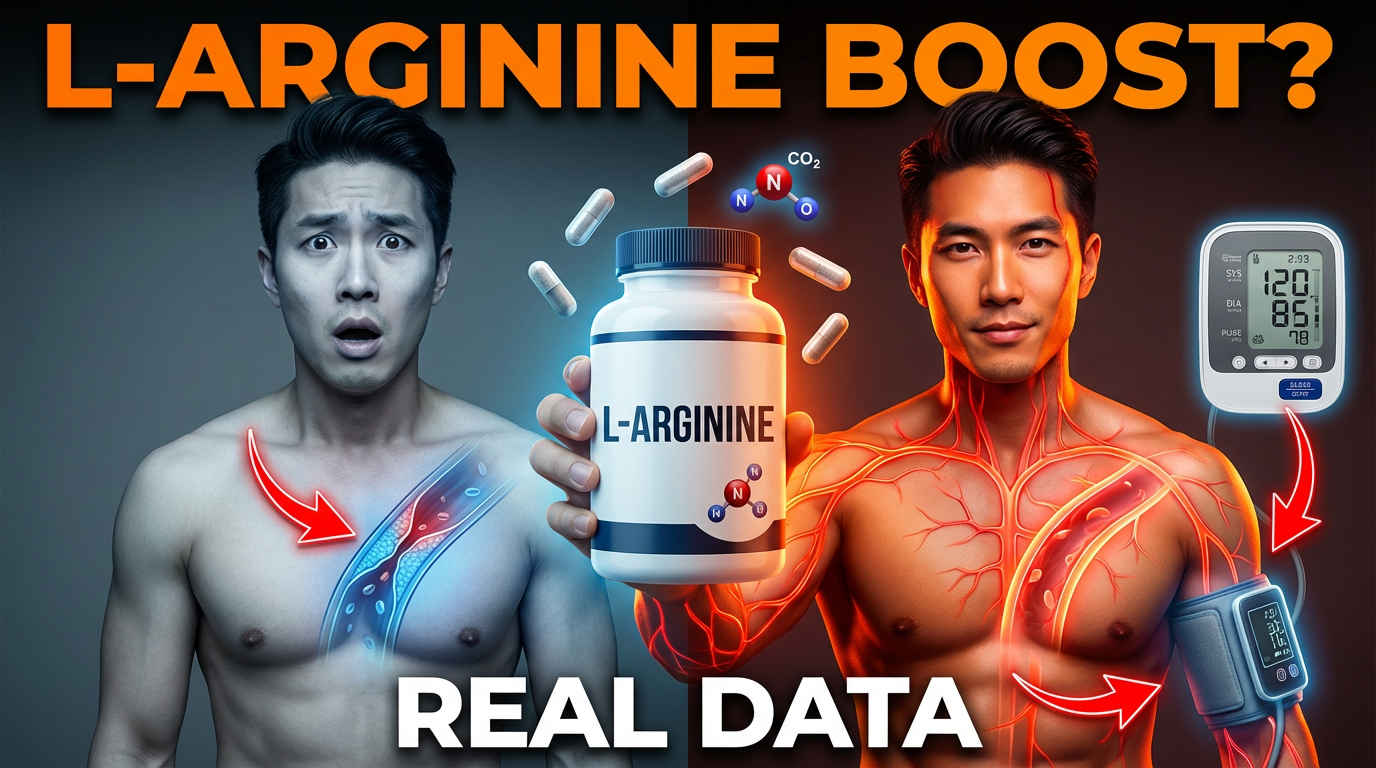
- L-arginine can support nitric oxide production (a key vasodilator pathway), but “better circulation” isn’t one single outcome—studies look at blood pressure, symptoms, and performance, and results vary.
- The best evidence is modest and context-dependent: blood pressure may drop slightly in some people; erectile function may improve for some men (especially in certain dose ranges and/or combinations); PAD is complicated and never “DIY-treatable.”
- Safety matters more than most people realise: if you take nitrates, antihypertensives, or PDE-5 inhibitors, or you’ve had a recent heart attack, you should speak with a clinician before adding L-arginine.
Introduction
You know that moment when you’re halfway through a workout and you get that tight “pump”—or when you check your home blood pressure and wonder if there’s anything you can do beyond “eat better and exercise more”? For a lot of people in Singapore, L-arginine shows up right around then: gym performance, “circulation support,” blood pressure, and (let’s be honest) erectile function. Here’s the thing: L-arginine does sit in a real, important biological pathway related to blood vessel tone. But supplement marketing often jumps from “supports nitric oxide” to “guaranteed better circulation,” and that’s where people get confused (or disappointed). This guide takes a conservative, research-led view of l-arginine benefits—especially for circulation and blood flow—plus practical dosing and label-reading tips, and clear safety guidance on who should talk to a doctor first. I’ll also point out where combination formulas can look more impressive than single ingredients, and why that can be both helpful and misleading depending on what you’re trying to solve. ---
Quick answer: do L-arginine benefits for circulation show up in real life?
What “better circulation” actually means (and why it’s easy to talk past each other)
When someone says “I want better circulation,” they might mean one (or several) of these:
- Lower blood pressure (resting numbers on a cuff)
- Better endothelial function (how well blood vessels dilate in response to signals)
- Improved symptoms (e.g., cold hands/feet, leg pain with walking, fatigue)
- Sexual blood flow and erectile response (which is its own topic)
- Exercise-related blood flow (the “pump,” perceived stamina, recovery)
Those aren’t interchangeable. A supplement could theoretically nudge one outcome without making a noticeable difference in another.
The balanced takeaway (what you can reasonably expect)
Based on the broader body of research and how nitric oxide biology works:
- Yes, L-arginine can support nitric oxide production, which can relax blood vessels (vasodilation).
- Yes, some studies show modest improvements in blood pressure or certain symptoms in specific groups.
- No, it’s not a cardiovascular medication, and it’s not a substitute for clinician-led care—especially if you have hypertension, diabetes, or suspected peripheral arterial disease (PAD).
If you’re generally healthy and curious, L-arginine may be a reasonable trial supplement. If you’re managing chronic disease risks (common in Singapore: hypertension, diabetes, high LDL, fatty liver), treat it more like a “discuss with your GP or pharmacist” situation than a casual add-on.
Who this article is for
This is for you if you’re any of the following:
- A gym-goer wondering whether nitric oxide production actually translates to better performance
- Someone with borderline or diagnosed high blood pressure who wants evidence-based options (without replacing prescribed meds)
- A man exploring ED supplements and trying to separate what’s supported vs. what’s overhyped
- Anyone stacking pre-workouts and “NO boosters” and thinking, Wait—how much am I actually taking?
---
What the research says about blood pressure (hypertension) and everyday circulation
What meta-analyses suggest (the “average effect” is modest)
A meta-analysis of randomized, double-blind, placebo-controlled trials reported that oral L-arginine supplementation lowered blood pressure compared with placebo, with an average reduction of about 5.39 mm Hg systolic and
2.66 mm Hg diastolic. If you’ve ever tried to lower your blood pressure through lifestyle, you’ll know those aren’t “nothing” numbers—but they also aren’t a guarantee, and they don’t apply equally to everyone. Supplements often show bigger effects in people who start off worse(e.g., higher baseline BP, poorer endothelial function) and smaller effects in already-healthy people.
How meaningful is a ~5 mm Hg systolic drop in real life?
Think of it this way: if your systolic is hovering around 138–145 mm Hg (a common “I’m not sure if I’m hypertensive” zone), a small reduction could move you closer to target ranges—if it’s consistent and if you’re also doing the boring-but-powerful basics (sleep, sodium awareness, weight management, activity, alcohol moderation). But blood pressure is also noisy:
- It changes with stress, caffeine, sleep debt, hydration, and measurement technique.
- People often take readings at inconsistent times (after rushing, after coffee, after a shower), then attribute normal fluctuations to a new supplement.
So if you trial L-arginine for BP: measure properly or you won’t know what’s real.
Why L-arginine isn’t a replacement for antihypertensive medication
This part matters, especially with Singapore’s high rates of hypertension and diabetes risk. Blood pressure meds aren’t just about numbers; they reduce cardiovascular risk over time, and they’ve got decades of outcomes data behind them. L-arginine research tends to be:
- shorter-term,
- more variable in dosing and populations,
- and less focused on hard outcomes (like stroke and heart attack prevention).
So the “right frame” is: could L-arginine be one supportive tool alongside lifestyle and medical care? Possibly. Should it replace your doctor’s plan? No.
Practical Singapore context: screening and home BP tracking that actually works
If you’re taking circulation support seriously, here’s a practical mini-checklist:
- Use a validated upper-arm cuff (wrist cuffs are often less reliable).
- Measure at the same time daily for 1–2 weeks (e.g., morning before coffee).
- Sit quietly for 5 minutes, feet flat, back supported, arm supported.
- Track:
- systolic/diastolic, - pulse, - sleep duration, - alcohol intake, - and whether you took any “NO booster” or pre-workout. If numbers are consistently elevated, don’t self-manage indefinitely. In Singapore, it’s easy to access a GP, polyclinic, or pharmacy-based screening—use it.
A note on combination formulas (and why they can feel “stronger”)
Many people don’t take plain L-arginine anymore—they take blends that target nitric oxide production from multiple angles. For example, Nano Singapore’s
L-Arginine Extreme (120ct) includes L-arginine plus L-citrulline (and supportive nutrients like calcium and niacin, depending on the label). That kind of formula can make practical sense because citrulline can raise arginine availability in the body through a different route than simply swallowing arginine. If you want to see how a combination product is positioned and what ingredients it uses, you can check the product page here:
L-Arginine Extreme - 120ct. (Even if you don’t buy it, reading product pages is a good way to train yourself to spot “transparent label vs vague blend” patterns.) ---
What the research says about erectile dysfunction (ED), peripheral arterial disease (PAD), and why “circulation” isn’t always the right word
ED: mixed evidence overall, but some men benefit (dose and context matter)
A systematic review and meta-analysis of randomized trials reported that L-arginine improved erectile function scores compared with placebo, with a pooled improvement on the IIEF-EF domain (the International Index of Erectile Function). Importantly, benefits appeared more evident in studies using doses ≥1.5 g/day(in subgroup analyses). That’s the scientific way of saying: some men do respond, but it’s not universal, and dose may matter.
Why ED results vary so much (it’s not one condition)
ED is an “end point,” not a single cause. Two people can have the same symptom with totally different drivers:
- Vascular / endothelial dysfunction (blood flow issue)
- Diabetes-related nerve and vessel changes
- Low testosterone (hormonal)
- Stress, anxiety, relationship dynamics
- Medication side effects (some antidepressants, BP meds, etc.)
- Smoking and heavy alcohol use
- Sleep apnea (very underrated contributor)
L-arginine is most plausible when the limiting factor is blood vessel dilation and nitric oxide signalling. It’s much less likely to solve ED that’s primarily hormonal, neurological, or psychological (though real life is often mixed).
L-arginine alone vs combination formulas (why combos may look better)
A lot of ED supplement studies use combination products(arginine + other botanicals/antioxidants), which can make the results look better than arginine alone. That doesn’t mean arginine is useless—it just means you shouldn’t over-credit one ingredient when five things changed at once. From a practical standpoint, combination formulas can be fine—if you can see:
- exact dosages (no proprietary “mega blend”),
- and you’re not stacking multiple products that quietly duplicate the same actives.
If you’re already taking a pre-workout plus a circulation product plus a “male vitality” blend, you can accidentally push your total daily dose high enough to cause side effects (especially GI upset).
PAD: a medical red flag, not just “poor circulation”
PAD (peripheral arterial disease) is when atherosclerosis narrows arteries to the legs. People often describe it as “poor circulation,” but clinically it’s a cardiovascular disease marker and raises risk for heart attack and stroke. Classic symptom: calf pain when walking that improves with rest(claudication). Other red flags: slow-healing foot wounds, skin colour changes, reduced pulses. Some studies and reviews suggest L-arginine supplementation may improve walking distance in PAD in certain settings, but evidence is not definitive—and long-term outcomes matter more than short-term treadmill gains. Here’s the “don’t get distracted” advice: if you suspect PAD, supplements are not your first move.
Medical assessment is.
PAD needs clinician-led risk reduction: smoking cessation, supervised walking therapy, lipid and BP management, glucose control, and sometimes medications or procedures.
Exercise performance and the “pump”: what’s plausible vs proven
This is where a lot of Singapore gym-goers land: “I don’t have ED or PAD; I just want better training.” Mechanistically, L-arginine can support nitric oxide production, and NO supports vasodilation. But in performance research, the chain: more arginine → more NO → better performance doesn’t always show up cleanly. Why?
- Oral arginine has limitations (it can be metabolised before it meaningfully raises circulating levels).
- Performance depends on many systems: energy production, neural drive, training status, sleep, hydration, carb intake, heat stress (Singapore’s humidity is not a small factor).
- What people feel (“pump”) doesn’t always match what studies measure (time-to-exhaustion, power output, repeat sprint ability).
If you’re chasing the “pump,” dietary nitrates (like beetroot) or citrulline sometimes show more consistent physiology in certain contexts. The U.S. NIH Office of Dietary Supplements also takes a cautious, evidence-graded approach when summarising performance ingredients—useful if you want a reality check on claims. ---
Dosage, label-reading, and safety: how to use L-arginine more wisely (and decide if it’s worth trying)
Common research doses (and why dose matters)
L-arginine dosing in studies is all over the place—part of why people get inconsistent results. A few practical points:
- For ED, benefits in some analyses appeared more evident at ≥1.5 g/day (in included studies), but many trials use higher doses than that.
- Higher doses can also mean more GI side effects (bloating, diarrhoea, nausea).
- Dividing doses (split dosing) is sometimes easier on the stomach than taking everything at once.
If you trial it, don’t do the “random scoop occasionally” approach. Decide on:
- a daily dose,
- a timing plan,
- and a tracking method.
Timing options: daily split dosing vs pre-exercise use
- Daily (split) dosing may make more sense if your goal is general circulation support or blood pressure.
- Pre-exercise dosing is more common for “pump” goals, but the evidence is mixed—and stacking with other pre-workout ingredients can complicate side effects.
If you’re someone who trains late, be careful with products that bundle stimulants. (L-arginine itself isn’t a stimulant, but many “performance” products are.)
Buyer guidance: how to evaluate supplement quality (without getting played)
If you’re going to buy supplements online, it helps to get a little “label-literate.” Here’s what I’d look for in Singapore: 1.
Clear ingredient list + exact dosages
Be cautious with “proprietary blends” that don’t disclose amounts. You can’t judge whether a product is under-dosed or over-dosed if the label hides the numbers. 2.
Manufacturing and testing signals
Look for basic quality markers: GMP manufacturing, reputable facility standards, and ideally some mention of third-party testing for impurities. For instance, Nano Singapore notes on its site that some products are formulated in Singapore and manufactured in facilities positioned as GMP-certified and FDA-registered (or equivalent), with third-party testing claims—use that as a type of information to look for across brands, not as a reason to ignore the rest of your due diligence. 3.
Avoid stacking duplicates
L-arginine can show up as: - L-arginine base, - arginine AKG, - and as part of multi-ingredient “nitric oxide production” blends. If you’re taking multiple products, do a quick tally of total daily arginine/citrulline intake. 4.
Be realistic about form
Capsules are convenient; powders can make higher doses easier (but taste and GI tolerance matter). Gummies are convenient but often under-dose amino acids because there’s only so much you can fit into a gummy. After you’ve got the basics down, browsing a curated catalogue like Nano Singapore’s
All Products collection can be a practical way to compare formulations and get a feel for what’s common in the market (capsules, blends, single-ingredient products).
Quick comparison: food, single supplements, blends, and “don’t forget medical care”
If you’re trying to decide what to do next, a simple comparison can help.
| Option | What it may support | Best for | Notes / trade-offs |
|---|---|---|---|
| Option | What it may support | Best for | Notes / trade-offs |
| Protein-rich foods (fish, poultry, soy, beans, nuts) | Baseline amino acid intake (including arginine) | People who want a food-first approach | Great foundation, but food arginine doesn’t always translate to noticeable “NO booster” effects; benefits come with broader nutrition changes. |
| L-arginine (single ingredient) | Nitric oxide pathway support; may modestly affect BP or specific symptoms in some people | Those who want a straightforward trial without extra actives | Dose matters; GI upset can occur at higher intakes; results vary by baseline health and meds. |
| L-citrulline (single ingredient) | Raises arginine availability indirectly; supports nitric oxide production | Training-focused readers chasing “pump” or endurance-style outcomes | Often discussed as more effective than arginine for raising circulating arginine; still not guaranteed performance gains. |
| Combination formulas (arginine + citrulline + supportive nutrients) | Multi-pathway support for nitric oxide production and performance positioning | People who prefer “all-in-one” dosing | Easier to stack too much if you’re also using pre-workouts; check labels for transparent dosages. Example of a blend format: Nano Singapore’s L-Arginine Extreme combines arginine and citrulline forms. |
Use this table as a decision filter: start with your goal(BP vs exercise vs ED), then choose the simplest option that fits that goal and your safety profile. The more complicated the stack, the harder it is to know what’s helping—and the easier it is to overshoot your dose.
Side effects and interactions: who should avoid L-arginine or consult a clinician
This is the part many people skip until something goes wrong.
Common side effects(especially at higher doses):
- stomach pain, bloating
- diarrhoea, nausea
- sometimes headache or worsening asthma symptoms in susceptible people
Higher-risk situations—talk to a doctor/pharmacist first:
- If you take nitrates (often for angina/chest pain): additive blood-pressure lowering can be dangerous.
- If you take antihypertensives: blood pressure may drop too low, especially if you also train hard, sauna, or restrict carbs aggressively.
- If you take PDE-5 inhibitors (e.g., sildenafil/tadalafil): again, additive BP-lowering is the concern.
- If you’ve had a recent heart attack: this is not a “DIY supplement” scenario; a clinical trial in post–myocardial infarction patients raised safety concerns and was stopped early.
- If you have recurrent herpes (cold sores/genital herpes): arginine is sometimes discussed as a potential trigger for recurrence in some individuals—worth discussing if you notice a pattern.
- Pregnancy/breastfeeding, kidney disease, liver disease, asthma, upcoming surgery: get individualised advice.
A Singapore-focused “is this worth trying?” checklist
Before you start: 1.
Name your primary goal
- Blood pressure support? - Exercise performance basics (pump/perceived endurance)? - Erectile function? - PAD symptoms? (If yes: stop here and seek medical assessment.) 2.
Medication/condition screen
Bring a list to your pharmacist or GP. In Singapore, pharmacists are often underused for supplement-medication interaction checks—use them. 3.
Pick a short, clean trial
- Choose one product. - Don’t change three other lifestyle variables in the same week. - Track one or two outcomes (BP averages, gym performance notes, erectile function quality, side effects). 4.
Know when to stop and seek care
Stop and get help if you get: - dizziness, fainting - chest pain - severe GI symptoms - worsening shortness of breath or asthma symptoms If nothing changes after a reasonable trial (often a few weeks), that’s useful information too. “No effect” is a result—and it can save you money and false hope. ---
Conclusion
L-arginine sits in real physiology: it’s part of nitric oxide production, and nitric oxide influences blood vessel dilation. But the research story is more modest than the marketing story. For blood pressure, average reductions across trials can be meaningful for some people, but it’s not a substitute for medication or proper monitoring. For ED, some men appear to benefit—especially at higher daily doses and/or in combination approaches—but results are mixed because ED itself has many causes. For PAD, “circulation support” shouldn’t distract you from the fact that it’s a medical red flag that needs clinician-led care. If you’re curious and generally healthy, you can trial L-arginine more safely by being dose-aware, label-literate, and cautious about interactions—especially if you’re stacking multiple “NO booster” products. And if you’re comparing options or trying to buy supplements online, it helps to keep your goal specific and your plan simple. buy supplements online
Frequently Asked Questions
FAQ 1
Is L-arginine better than just eating protein foods?
Not “better,” just different. Protein-rich foods support baseline arginine intake and overall cardiovascular nutrition. Supplements are more targeted (and higher-dose), which is why they can have stronger effects and stronger side effects.
FAQ 2
Can I take L-arginine with coffee, creatine, or a pre-workout?
Usually yes for coffee/creatine, but be careful with pre-workouts because you may unknowingly stack multiple vasodilator ingredients (arginine, citrulline, nitrates) and increase GI upset or low-blood-pressure risk. If you’re on BP meds, nitrates, or PDE-5 inhibitors, ask a clinician first.
FAQ 3
Is L-arginine safe long-term?
Many people tolerate it, but long-term safety depends on your dose, health status, and medications. It’s not recommended after a recent heart attack without medical advice, and it can interact with blood pressure–lowering drugs.
FAQ 4
What’s the difference between L-arginine and L-citrulline?
L-arginine is the direct substrate used to make nitric oxide. L-citrulline can raise arginine availability indirectly and is often discussed as a more reliable way to increase circulating arginine. In practice, some people respond better to one than the other.
FAQ 5
Does L-arginine help women’s circulation?
Potentially for certain endpoints (like blood pressure or endothelial function), but the evidence base is less “headline-friendly” than ED-focused discussions. If you’re considering it for BP, measure properly and discuss interactions—especially if you’re on antihypertensives or have migraine/low BP tendencies.
References
- https://www.mayoclinic.org/drugs-supplements-l-arginine/art-20364681
- https://jamanetwork.com/journals/jama/fullarticle/202136
- https://ods.od.nih.gov/factsheets/ExerciseAndAthleticPerformance-HealthProfessional/
- https://pmc.ncbi.nlm.nih.gov/articles/PMC9340976/
- https://www.sciencedirect.com/science/article/pii/S1743609518313626
- https://pmc.ncbi.nlm.nih.gov/articles/PMC10376856/
- https://pubmed.ncbi.nlm.nih.gov/25109592/
- https://pubmed.ncbi.nlm.nih.gov/30704254/
- https://pubmed.ncbi.nlm.nih.gov/27402812/