Key Takeaways
- Turmeric in food and curcumin supplements aren’t interchangeable—supplements can deliver far more curcuminoids than cooking, which changes both expectations and safety considerations.
- Human studies suggest curcumin may help knee osteoarthritis symptoms for some people, but results vary by dose, formulation, and who’s taking it—so think “adjunct,” not “replacement.”
- “Enhanced absorption” (especially with piperine/black pepper) can boost curcumin exposure dramatically, which may improve odds of benefit but can also raise interaction and side‑effect risk.
Introduction
If you've ever stood up after a long kopi session, taken a few steps, and felt that familiar creakiness in your knees (or that stiff ache in your fingers when you grip your phone), you've probably had the thought: Should I do something about this now… before it gets worse?
In Singapore, turmeric is practically a pantry staple—tucked into curries, soups, stir-fries, and the occasional "golden milk" phase someone in the family tries for a week. At the same time, curcumin supplements are everywhere online, promising "joint support" in tidy capsules. It's easy to assume they're basically the same thing, just different packaging.
Here's the thing: turmeric powder in your cooking and a concentrated curcumin supplement can be worlds apart in potency, absorption, and safety. And when we're talking about joint comfort—especially for knee osteoarthritis or persistent joint stiffness—those details matter.
This guide will walk you through what turmeric and curcumin actually are, what the human evidence suggests for joint-related outcomes, how "enhanced absorption" changes the equation, and how to use these products safely alongside first-line joint care (movement, strengthening, weight management, and clinician-guided treatment when needed).
Turmeric vs curcumin: what’s the real difference (and why it matters for joint comfort)?
Turmeric (spice) contains curcumin—but only a small fraction
Turmeric is the yellow-orange spice made from the rhizome of Curcuma longa. Curcumin is one of the naturally occurring compounds inside turmeric, and it's the one most often studied for inflammation-related pathways.
But turmeric isn't "all curcumin." In fact, whole turmeric contains a relatively small proportion of curcuminoids—curcumin is commonly described as a minor fraction by weight, and detailed references often place it in the low single-digit percentages range depending on the extract and how it's measured. That's one reason why turmeric in food doesn't automatically translate to "clinical-dose curcumin."
So yes, cooking with turmeric is a healthy habit for many people. But if your expectation is "I'll sprinkle turmeric on my eggs and it'll work like the osteoarthritis trials," you're setting yourself up for disappointment.
Why supplements can deliver much higher, standardised curcuminoid doses than food
Supplement formulations often use turmeric extracts that are standardised—meaning the label specifies something like “95% curcuminoids” or “X mg curcumin/curcuminoids per serving.” That’s a totally different concept from a teaspoon of spice, where the curcumin content can vary widely by brand, freshness, and processing. In Singapore stores and online marketplaces, you’ll typically see a few broad categories:
- Turmeric powder capsules (basically “spice in a capsule”)
- Turmeric extract / curcumin extract capsules (more concentrated; may be standardised)
- Curcumin with absorption enhancers (e.g., piperine/black pepper extract, phytosome-style delivery, micelles, nano-formulations)
This is also where safety comes in: higher concentration means higher exposure—and that can change your risk profile, especially if you take medications.
What this means for expectations: cooking turmeric ≠ trial-strength curcumin
A practical way to think about it:
- Turmeric in food: great as part of an anti-inflammatory lifestyle pattern (more whole foods, spices, fibre, colourful plants), but usually a low, variable curcumin dose.
- Standardised curcumin supplements: closer to what’s used in clinical research, but require more careful label reading and safety screening.
- Enhanced-bioavailability curcumin: potentially more “effective per mg,” but also more likely to interact or cause side effects in susceptible people.
If your main goal is joint comfort, the supplement route is where evidence is more directly studied—but it’s also where you need to be more thoughtful.
Can turmeric/curcumin help joint comfort? What human evidence says (and what still matters more)
The biological rationale: anti-inflammatory and antioxidant activity (why researchers study it)
Most interest in curcumin for joint stiffness comes from its relationship with inflammation and oxidative stress. In osteoarthritis (OA), we’re not only dealing with “wear and tear”—there’s also a complex interplay of cartilage breakdown, inflammatory signalling, muscle weakness around the joint, and pain sensitisation. Curcumin is studied because it may influence inflammatory pathways in ways that could plausibly reduce symptom burden in some people.
But “plausible biology” isn’t the same as “guaranteed relief.” Clinical outcomes still depend on:
- the formulation (absorption matters a lot),
- the dose (and whether it matches what’s studied),
- the population (mild vs advanced OA, baseline inflammation, activity level),
- and what else the person is doing (exercise, weight management, physiotherapy, medication).
Knee osteoarthritis: what systematic reviews/meta-analyses generally find (benefits and limits)
When you zoom out to the best available summaries (systematic reviews and meta-analyses), a consistent theme shows up:
- Some trials report improvements in pain and function, especially for knee OA.
- Study quality varies, and different products/doses make results harder to compare.
- Most studies are short-term (often weeks to a few months), so long-term outcomes aren’t as clear.
That means curcumin can be reasonable to consider for symptom support—especially if you’re trying to reduce reliance on frequent painkillers—but it’s not a cure, and it won’t rebuild cartilage.
Curcumin vs NSAIDs in some trials: what ‘similar relief’ does (and doesn’t) mean
You’ll sometimes see headlines like “curcumin works as well as ibuprofen.” What should you do with that?
- In some studies, certain turmeric/curcumin preparations appear to provide symptom relief that looks comparable to common pain relievers for some outcomes.
- But comparisons depend heavily on study design, blinding, participant expectations, and whether the curcumin formulation actually achieves meaningful blood levels.
- Even if symptom relief is similar, NSAIDs and curcumin are not interchangeable in how they work, how predictable the dosing is, and how clinicians monitor safety.
If you’re currently on prescribed therapy (or using NSAIDs frequently), don’t swap in curcumin as a DIY substitute without talking to a clinician—especially if you have cardiovascular, kidney, gastrointestinal, or bleeding-risk issues.
Who might consider it—and who shouldn’t “wait it out”
Curcumin tends to make the most sense as a trial for:
- mild-to-moderate knee OA discomfort,
- intermittent joint stiffness,
- people who are already doing the “boring but effective” basics (strengthening and activity),
- and those who want an adjunct option with a relatively reasonable short-term safety profile when used appropriately.
On the other hand, don’t self-treat and delay care if you have red-flag symptoms such as:
- a hot, swollen joint,
- redness spreading,
- fever,
- sudden inability to bear weight,
- new severe pain after a fall,
- or rapidly worsening function.
Those patterns raise concern for inflammatory arthritis, infection, gout flare, fracture, or other problems that need proper assessment—not turmeric experiments.
Joint comfort fundamentals (what still works best in real life)
If you remember only one thing from this article, let it be this: supplements are the smallest lever; movement habits are the big lever.
Evidence-based guidelines consistently prioritise:
- exercise and strengthening (especially around the knee and hip),
- weight management when relevant,
- education and pacing (learning how to do more without flaring symptoms),
- and targeted medical care when needed.
Even modest weight loss can meaningfully reduce load across the knees during daily walking. And strengthening the muscles around a joint can improve stability and pain sensitivity over time—often more reliably than any capsule. Curcumin can sit neatly on top of that foundation as an adjunct, but it can’t replace it.
Bioavailability 101: why curcumin absorption is low—and why “enhanced” products change the equation
Curcumin is poorly absorbed by mouth on its own
One of the most confusing parts of curcumin is that you can swallow a meaningful dose and still get very low measurable levels in the bloodstream—because curcumin is poorly absorbed and rapidly metabolised. So when someone says, “I tried turmeric capsules and nothing happened,” it might not mean turmeric “doesn’t work.” It might mean:
- the product wasn’t standardised,
- the dose was too low (relative to studied doses),
- the formulation wasn’t absorbed well,
- or the person’s joint pain wasn’t the kind that responds to that pathway.
Piperine/black pepper extract and other delivery technologies: what “enhanced absorption” means
To get around low absorption, many supplements include:
- piperine (from black pepper), or
- delivery systems like phytosomes, micelles, or other “bioavailable” designs.
Piperine is popular because it can increase curcumin absorption substantially. But “more absorbed” is a double-edged sword: you may get a stronger effect, but you may also raise the likelihood of side effects or medication interactions.
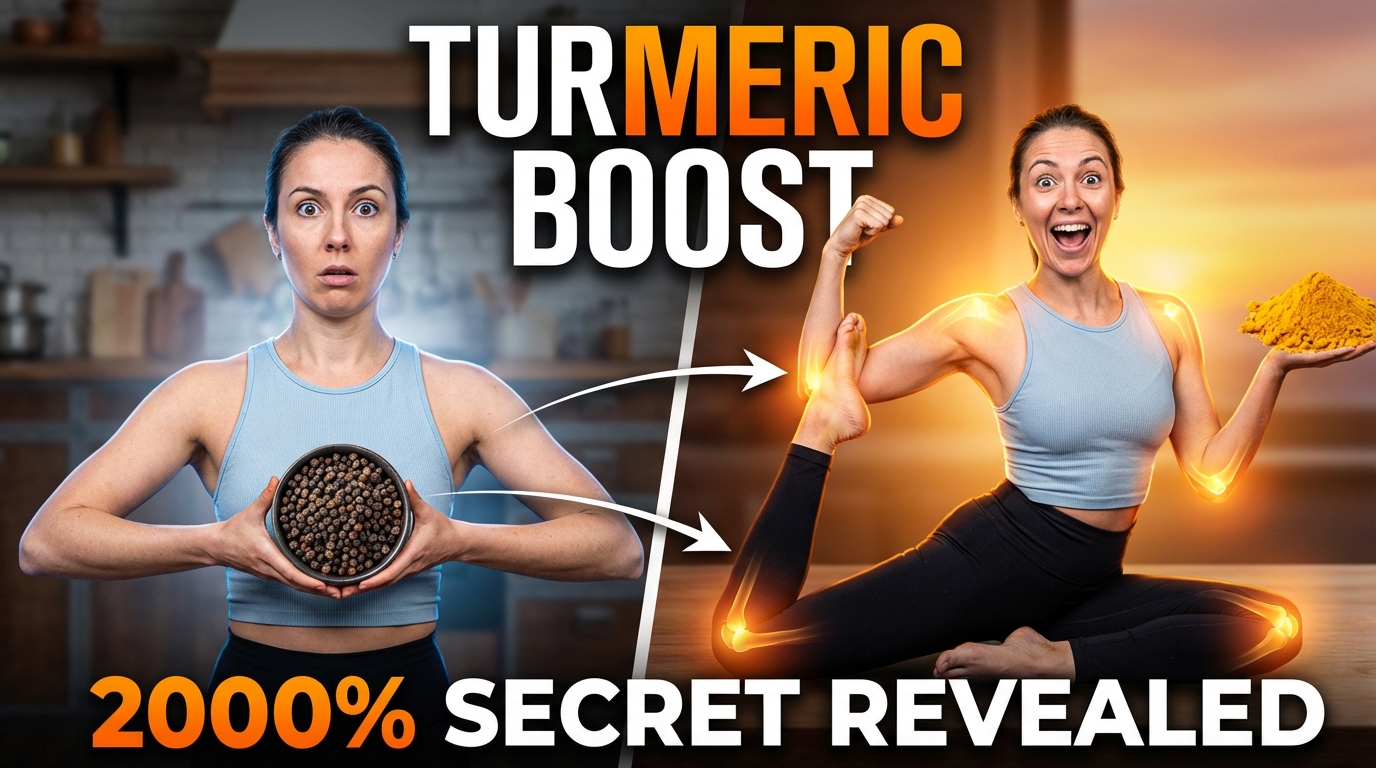
Key stat to know: piperine increased bioavailability by 2,000% in a human volunteer study
A classic human volunteer study found that combining curcumin with piperine dramatically increased curcumin bioavailability—often quoted as
2,000% in that setting. This stat is the reason you’ll see many joint and “anti-inflammatory” formulas marketed as “with black pepper.” It’s not random. It’s pharmacokinetics.
Why higher absorption can mean stronger effects—and higher interaction risk
This is where safety becomes very real, very quickly. When you enhance absorption, you’re potentially changing how the body handles not just curcumin, but also other substances processed through overlapping pathways. This matters especially if you:
- take blood thinners (anticoagulants/antiplatelets),
- take multiple long-term medications (polypharmacy),
- have liver conditions or a history of medication sensitivity,
- or are preparing for surgery.
There have also been increasing public health conversations about rare liver injury associated with some turmeric/curcumin products—particularly higher-dose and/or enhanced-bioavailability forms. Regulators have issued safety communications noting that while culinary turmeric is generally not the concern, medicinal-dose products have been associated with rare but potentially serious liver problems in susceptible individuals. None of this means you must avoid curcumin.
It means you should treat it like a potent supplement—because it can be.
A simple, safer way to trial curcumin for joint stiffness
If you and your clinician/pharmacist agree it’s appropriate, a practical approach is: 1.
Choose one product (don’t stack).
Don’t do turmeric tea + turmeric capsules + a joint blend all at once. You won’t know what’s helping—or what’s causing side effects. 2.
Start low for 1 week.
GI side effects (nausea, reflux, loose stools) are common reasons people quit early. Starting low improves tolerance. 3.
Take with food.
Many people do better with curcumin taken with meals. 4.
Set a time-boxed trial (e.g., 8–12 weeks).
Joint symptoms fluctuate naturally. A defined trial window helps you assess patterns without “forever supplementing” on autopilot. 5.
Track 2–3 concrete outcomes.
For example: “morning stiffness minutes,” “stairs pain score,” “walk duration before discomfort.” If nothing changes after a fair trial, that’s useful information. It may be time to pivot back to physiotherapy progression, footwear changes, sleep optimisation, or medical review rather than increasing dose endlessly.
How to choose a curcumin supplement in Singapore (label-reading checklist + safety guide)
Let’s make this practical. If you’re standing in Watsons, scrolling a marketplace listing, or trying to buy supplements online, the label tells you almost everything you need—if you know what to look for.
Look for standardisation: curcumin/curcuminoids in mg per serving (not just “turmeric extract”)
A lot of labels rely on vague wording:
- “Turmeric complex”
- “Curcuma blend”
- “Herbal anti-inflammatory”
Instead, look for clarity:
- Curcumin or curcuminoids listed in mg per serving
- Standardisation language such as “95% curcuminoids”
- A clear serving size (e.g., 1 capsule vs 2 capsules)
This matters because research outcomes can’t be generalised to a product that doesn’t disclose what you’re actually taking.
Form matters: with piperine vs non-piperine options (and when to avoid piperine)
With piperine/black pepper extract can be useful if:
- you’re not on medications with interaction concerns,
- you’re trying to match the “enhanced absorption” approach used in many formulations,
- and you tolerate it well.
But consider piperine-free enhanced forms(or speak with a pharmacist) if:
- you’re on multiple medications,
- you’re sensitive to GI irritation,
- you have complex medical history where predictable metabolism matters.
Piperine isn’t “good” or “bad.” It’s a tool. The question is whether it’s the right tool for you.
Quality and transparency signals: what I’d personally want to see
Because supplements aren’t regulated like prescription medicines, your best defence is choosing companies that behave like they expect scrutiny. Look for:
- GMP manufacturing statements (Good Manufacturing Practices)
- Third-party testing or impurity testing where available
- Clear allergen info
- A warnings section that doesn’t pretend the product is risk-free
- Contactable customer support (a real sign a brand expects questions)
On Nano Singapore’s site, you’ll notice product pages often highlight manufacturing and quality cues and also remind users not to “double up” on similar ingredients—an underrated safety message in a world where people stack products casually.
Where Nano Singapore fits (example, not a prescription)
If you’re looking for a turmeric-based option in the joint-support space, Nano Singapore’s
Turmeric Curcuma 1,600mg - 120ct is an example of a formula positioned around turmeric/curcuma and enhanced absorption (it’s described as paired with black pepper/BioPerine-style support on the product page). You can view it here:
Turmeric Curcuma 1,600mg - 120ct. If you’re comparing broader joint-support options (not just turmeric), their
Joints, Bones & Muscles collection can be a useful “menu” to understand common ingredient categories people consider (from turmeric-focused products to other joint blends):
Joints, Bones & Muscles Supplements. The key is not to treat any single product as the answer—but to use it as one component in a plan you can sustain.
Comparison table: quick ways to choose between common options
Most people don’t need more information—they need a clearer decision. Here’s a quick comparison of common approaches you’ll see in Singapore.
| Option | Key benefits (realistic) | Best for | Notes / watch-outs |
|---|---|---|---|
| Option | Key benefits (realistic) | Best for | Notes / watch-outs |
| Turmeric in food (curries, soups, golden milk) | Adds polyphenols and flavour; supports a healthier overall dietary pattern | People who want a gentle, food-first approach | Curcumin dose is low/variable; won’t match trial-strength dosing; usually safest for most |
| Standardised curcumin extract capsule (e.g., “95% curcuminoids”) | More consistent dosing than food; closer to research setups | People trialling curcumin for knee OA symptoms | Check mg per serving; watch GI upset; don’t stack multiple curcumin products |
| Curcumin + piperine (black pepper extract) | Higher absorption; may improve odds of symptom benefit for some | People who tolerate it and aren’t on high-risk meds | Interaction risk can be higher; extra caution with blood thinners and polypharmacy |
| Joint blends (e.g., glucosamine/chondroitin/MSM-style formulas) | Different mechanism: cartilage building blocks + symptom support in some users | People who prefer a multi-ingredient joint approach | Evidence varies by ingredient and individual; still needs time-boxed trial and label scrutiny |
| First-line care (strengthening + aerobic activity + weight management + physio) | Strongest evidence for function and long-term management | Almost everyone with OA or chronic joint stiffness | Requires consistency; may need tailoring; supplements are adjuncts, not substitutes |
How to read this table: start from the bottom row (first-line care) and work upward. Supplements can help with symptom management for some people, but the “base layer” is what protects function over time. Also, notice how the “best for” column is about fit—not hype.
Avoid “stacking”: how accidental high dosing happens
This is one of the most common real-world problems I see:
- Morning: turmeric latte
- Lunch: joint blend capsule
- Dinner: curcumin + piperine capsule
- Plus: an “anti-inflammatory” drink powder on weekends
Nothing here looks extreme in isolation. Together, you can end up with a much higher combined curcuminoid dose than you intended—plus multiple absorption enhancers—plus no clear idea what caused your reflux, bruising, or abnormal lab results. Pick one approach, keep it stable for a few weeks, and assess.
Who should use extra caution (or avoid) curcumin supplements
This is the “please don’t skip” part:
- Blood thinners / bleeding risk: Turmeric in large supplemental doses may act like a blood thinner and can increase bleeding risk or enhance the effects of blood-thinning medications. If you take anticoagulants or antiplatelet meds, speak to a clinician first.
- Upcoming surgery: Many reputable resources advise stopping turmeric supplements ahead of surgery due to bleeding concerns—confirm timing with your surgical team.
- Gallstones or bile duct obstruction: Turmeric can worsen gallbladder issues in some people. If you’ve had gallbladder attacks, stones, or bile duct problems, this is a “talk to your doctor” situation, not a “try and see.”
- Pregnancy/breastfeeding: Culinary use is generally different from medicinal-dose supplementation. Many references advise avoiding medicinal amounts during pregnancy and using caution while breastfeeding.
- Liver concerns: Rare liver injury has been reported with some turmeric/curcumin products, particularly higher-dose and enhanced-bioavailability formulations. If you develop symptoms like dark urine, severe fatigue, poor appetite, or jaundice—stop and seek medical advice.
None of this is meant to scare you. It’s meant to keep you from treating a concentrated herbal extract like it’s the same as a teaspoon of curry powder.
Conclusion
Turmeric and curcumin sit in a genuinely interesting space: they're traditional, widely used, and backed by a growing body of human research—especially for knee osteoarthritis symptoms. But the details matter. Turmeric in food and standardised curcumin extracts aren't interchangeable, absorption-enhanced products change both the potential upside and the potential risk, and joint comfort still depends heavily on the unglamorous basics: movement, strengthening, load management, and getting the right medical input when symptoms aren't straightforward.
If you decide to try a curcumin supplement, treat it like a purposeful, time-boxed experiment: choose a transparent product, start low, avoid stacking, and check interactions—especially if you're on blood thinners or have gallbladder or liver concerns.
And if you want a convenient, curated place to compare options, you can buy supplements online.
Frequently Asked Questions
FAQ 1
Is turmeric powder in cooking enough for joint pain? For many people, culinary turmeric is a healthy addition to meals, but it usually delivers a much smaller and more variable curcumin dose than what’s studied in osteoarthritis trials. If you’re looking for trial-like effects, a standardised supplement is closer—but it also requires more safety screening.
FAQ 2
Is “with black pepper” always better? Not always. Black pepper extract (piperine) can boost absorption, which may help some people—but it can also increase interaction risk, especially if you take multiple medications. “Better” depends on your meds, your tolerance, and your goal.
FAQ 3
Can I take curcumin with aspirin/warfarin/clopidogrel? This is a “talk to your clinician/pharmacist first” situation. Concentrated turmeric/curcumin (especially enhanced-absorption forms) may increase bleeding risk or amplify blood-thinning effects. Don’t guess—get personalised advice.
FAQ 4
What side effects should make me stop? Stop and seek medical advice if you notice signs of possible liver issues (dark urine, jaundice, severe fatigue, persistent nausea, poor appetite) or unusual bruising/bleeding. For milder GI upset (reflux, diarrhoea), consider lowering the dose or stopping—especially if symptoms are persistent.
FAQ 5
How do I tell if it’s helping vs normal symptom fluctuation? Use a simple tracking method for 2–3 measures (e.g., morning stiffness minutes, stair pain score, walking duration). Keep everything else stable for 6–12 weeks. If improvements are consistent and meaningful, it’s more likely the supplement is contributing.
References
- https://www.nccih.nih.gov/health/turmeric
- https://www.ncbi.nlm.nih.gov/books/NBK548561/
- https://bmccomplementmedtherapies.biomedcentral.com/counter/pdf/10.1186/s12906-022-03740-9.pdf
- https://procurvesplus.com/estudios/piperine%26curcumin.pdf
- https://www.komen.org/breast-cancer/survivorship/complementary-therapies/turmeric/
- https://www.tga.gov.au/safety/safety-monitoring-and-information/safety-alerts/medicines-containing-turmeric-or-curcumin-risk-liver-injury
- https://www.nhs.uk/conditions/osteoarthritis/
- https://www.healthquality.va.gov/HEALTHQUALITY/guidelines/CD/OA/VADODOACPG.pdf
- https://www.arthritis.org/health-wellness/healthy-living/nutrition/weight-loss/oa-diagnosis-why-weight-loss-matters
- https://www.healthline.com/nutrition/turmeric-dosage
We at Nano Singapore Shop encourage you to consult a doctor before making any health or diet changes, especially any changes related to a specific diagnosis or condition.