
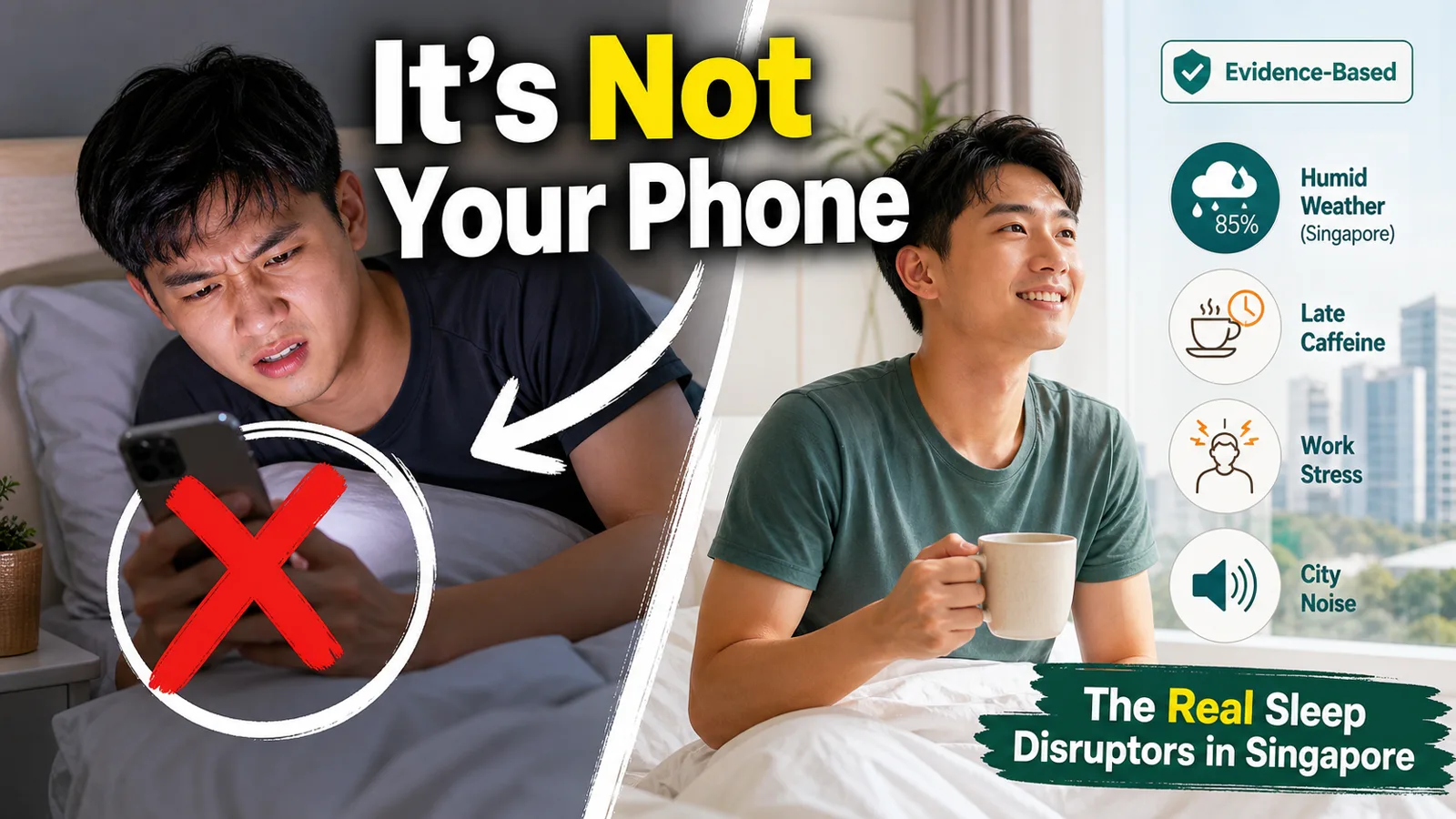
Key Takeaways
- 1 in 3 Singaporeans sleeps fewer than 7 hours on weekdays.
- Singapore's average nightly temperature is 27–29°C, far above the optimal 18–21°C for deep sleep.
- An MRT commute of 60–90 minutes each way can cut total sleep by over an hour nightly.
- Caffeine from a 9pm kopi-O can keep you alert until 2–3am due to its 5–6 hour half-life.
- 80–90% average humidity impairs your ability to cool down for sleep—no phone required.
Sleep deprivation (Singapore context): A state where an individual consistently gets fewer than 7 hours of sleep nightly. This is recognised by Singapore’s Health Promotion Board as a critical health issue linked to chronic diseases, mental health challenges, and daytime fatigue. In Singapore, unique stressors—chronic heat, late commutes, hawker caffeine, and dense housing noise—make this risk especially acute, beyond what most global sleep advice assumes.
Why can't Singaporeans sleep — and is it really caused by phones?
Singaporeans are sleep-deprived primarily because of environmental and physiological factors unique to equatorial urban living—not screen time.
- Singapore's nighttime temperatures rarely fall below 25°C, disrupting the body's core temperature drop needed for deep sleep.
- Caffeine from a 9pm kopi-O at a hawker centre lingers with half its effect until 2–3am.
- HDB corridor noise, late renovations, and long MRT commutes fragment sleep even for those with zero screens at night.
| Factor | Typical Impact | Singapore Example |
|---|---|---|
| Heat/Humidity | Delays sleep onset | Night temps 27°C, humidity 80–90% |
| Caffeine | Blocks sleep up to 6 hours | Kopi-O at 9pm = alertness until 3am |
| Noisy Neighbours | Disrupts deep/restorative sleep | HDB works allowed until 10pm |
| Commute | Cuts sleep by 1–2 hours | MRT ride from Woodlands: up to 90 min |
- Environmental stressors dominate sleep problems in Singapore.
- Phones contribute, but are not the main culprit.
Is Singapore Actually One of the Most Sleep-Deprived Cities on Earth?
What the data says about Singaporean sleep duration
Singapore regularly ranks among the most sleep-starved cities in global consumer data.
1 in 3 Singaporeans sleeps fewer than 7 hours per night on weekdays (HPB Singapore).
- Jawbone's 2016 consumer data ranked Singapore last among 50 global cities: just 6 hours, 32 minutes average nightly sleep.
- Health Promotion Board (HPB) recommends 7–9 hours per night for adults.
| Measure | Singapore | HPB Recommendation | NYC |
|---|---|---|---|
| Weeknight Sleep (avg) | 6:32 hours | 7–9 hours | Over 7:00 hours |
| % Getting <7 Hours | 33% | 0% (target) | 24% |
Why Western sleep research misses the Singapore picture
Most global sleep studies focus on temperate climates where heat and humidity are not persistent disruptors.
- Western-centric research often blames screens or light, not tropical environment.
- Equatorial heat, HDB density, and hawker caffeine are rarely studied in sleep science.
- Singapore's 24-hour economy means routines, work, and social life often delay bedtime far beyond global norms.
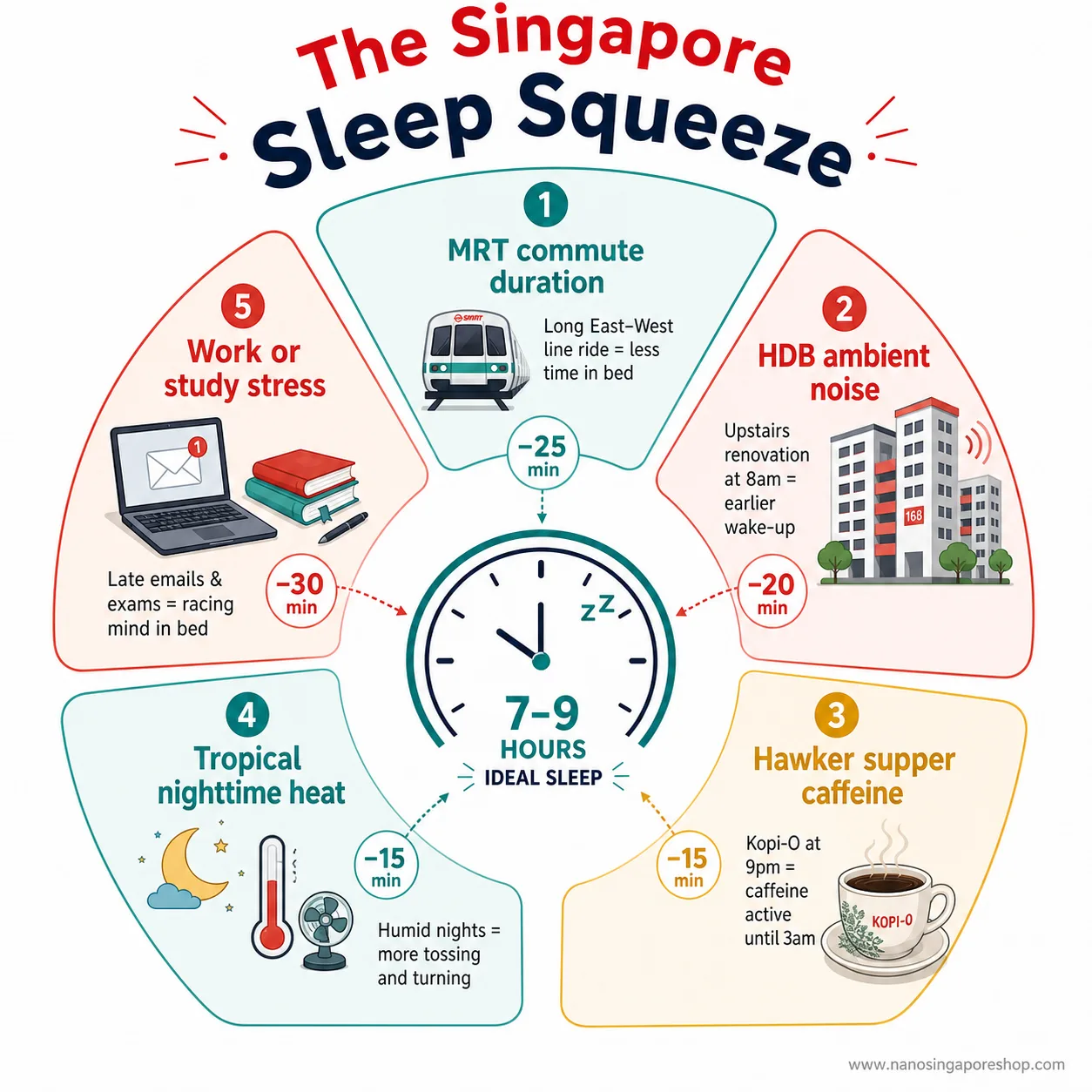
| Sleep Disruptor | Singapore Prevalence | US/EU Prevalence |
|---|---|---|
| Nighttime Temp >25°C | Daily | Rare in temperate zones |
| Late Kopi/Teh Culture | Common | Rare |
| Commute >1 Hr | Frequent (suburbs) | Less common |
- Singapore's sleep loss is structurally different from the West.
Is Singapore Too Hot for Deep Sleep? What 27°C Nights Do to Your Brain
Yes — Singapore is too hot for deep sleep; nightly temperatures of 27–29°C prevent the core body temperature drop the brain requires to enter deep sleep.
With 5mg of melatonin per serving, Deep Sleep Extreme Sleeping Gummies help lower core body temperature, enabling the brain to enter deep sleep even when ambient temperatures remain around 27°C. This aligns directly with the need for that temperature drop to improve sleep quality in hot environments like Singapore.

Why your core body temperature must fall before you can sleep
Deep sleep depends on a 1–2°C core body temperature drop. Sleep onset is delayed if this doesn't happen.
Optimal sleep onset temperature: 18–21°C. Singapore’s average night: 27–29°C (year-round).
| Temperature | Sleep Effect | Singapore Reality |
|---|---|---|
| 18–21°C | Easy sleep onset, full deep/REM cycles | Rare indoors without AC |
| 22–25°C | Slight difficulty falling asleep | Common in AC rooms |
| 26–29°C | Disrupted slow-wave and REM sleep | External air, uncooled rooms |
- Human sleep drive starts with cooling by about 1–2°C, usually two hours before sleep.
- In Singapore, ambient heat blocks this cooling every single night.
How Singapore's tropical humidity makes thermoregulation harder
Humidity in Singapore averages 80–90%. It impairs sweat evaporation—the main way the body cools for sleep.
Year-round humidity in Singapore: 80–90%.
- No evaporation = less cooling = more tossing, turning, and shallow sleep.
- Even with air-con, the thermal problem is not fully solved. Melatonin production is also affected by constant light and heat.
- HPB now acknowledges "thermal comfort" as crucial for better sleep in local guidelines.
| Sleep Factor | Singapore | Science-Optimal |
|---|---|---|
| Nighttime Temp (°C) | 27–29 | 18–21 |
| Humidity (%) | 80–90 | 40–60 |
| Melatonin Support | Suppressed by light/heat | Adequate in darkness/cool |
- Thermal sleep disruption is the physiological interference with sleep onset caused by ambient temps above 25°C—Singapore’s status quo.
- This makes it nearly impossible for some to enter deep slow-wave sleep without the right environment.
How Your MRT Commute Is Stealing an Hour of Sleep Every Night
Long commutes, especially via MRT from outer towns, compress your sleep window—even before work or stress get involved.
The commute-bedtime compression effect in Woodlands, Punggol, and Jurong West
Average MRT commute adds 45–90 mins of daily travel for many Singaporeans (LTA data).
- Residents in Woodlands, Punggol, and Jurong West often travel 60–90 minutes each way.
- This shrinks the gap between arriving home and ideal bedtime.
- “Compressing” the sleep window means less than 6 hours in bed is common, not a discipline failure.
Why arriving home at 8pm makes a midnight bedtime almost inevitable
| Weeknight Timeline | Time | Actual Activity | Brain's Ideal |
|---|---|---|---|
| Arrive Home | 8:00pm | Dinner, unwind | Light snack, relax |
| Supper/Caffeine | 9:00pm | Kopi/Teh with friends/family | Avoid stimulants |
| Emails/TV | 10:30pm | Catch-up on work/FYP | Dim lights, quiet time |
| Bedtime | 12:00am | Finally in bed | 10:30–11:00pm |
| Alarm | 6:00am | Wake up | Wake rested |
- Circadian misalignment is when your body clock no longer matches your mandated wake time, leading to persistent tiredness.
- This is why many ask: "Why am I always tired, even if I technically get 6 hours in bed?"
Is Your 9pm Kopi-O Keeping You Awake Until 3am?
A late-night kopi or teh at a hawker centre can delay your sleep by hours—even if you put the phone away.
How caffeine's half-life maps onto hawker supper culture
A kopi-O at 9pm has half its caffeine power left at 2–3am (5–6 hour half-life).
- Singapore’s food culture celebrates supper, but common drinks like kopi-O (approximately 80–100mg caffeine, though this varies by preparation) and teh tarik deliver a hidden night-time dose.
- Caffeine blocks adenosine—the key sleepiness signal in the brain—for up to 6 hours post-consumption.
| Beverage | Caffeine per Cup (mg) | Half-Life (Hours) | Alertness Window |
|---|---|---|---|
| Kopi-O | 100 | 5–6 | 9pm–3am |
| Teh Tarik | 40–60 | 5–6 | 9pm–2am |
| Americano (morning) | 95 | 5–6 | 9am–3pm |
Why kopi and teh tarik are a different caffeine risk than morning coffee
- Morning caffeine is usually metabolised fully by night. Nighttime kopi is not.
- Even a "weak" teh can delay sleep onset, reduce deep sleep, and cause adenosine rebound—sudden tiredness the next morning.
| Time Consumed | Supper Kopi | Morning Coffee |
|---|---|---|
| Sleep Disruptive? | Yes (half-life overlaps sleep) | No (fully cleared by bedtime) |
| Common in SG? | Very (hawker suppers) | Moderate (office) |
- Caffeine-driven insomnia is common and comes without warning—even if you "feel sleepy" after supper.
Why HDB Living and Urban Density Fragment Singaporeans’ Sleep
HDB living fragments sleep because shared walls, corridor noise, and light pollution create constant micro-arousals throughout the night — independent of phone use. High-density HDB environments create noise and light disruptions non-stop—even without phones in the picture.
How corridor noise, renovations, and light pollution break up sleep cycles
HDB renovations are legally allowed until 10pm; night deliveries and corridor chatter are normal after midnight.
- Shared walls and corridors mean every neighbour’s door, footsteps, and lift arrival can fragment your sleep.
- Singapore’s open common spaces allow voices, sounds, and minor commotion to echo into bedrooms long after lights-out.
| HDB Sleep Disruptor | Time Most Common | Impact |
|---|---|---|
| Renovation Noise | 7pm–10pm | Sleep delay, stress |
| Corridor Chatter | 10pm–12am | Sleep fragmentation |
| Lift/Early Deliveries | 4am–7am | Premature waking |
- Light pollution from corridor or street lights also suppresses melatonin.
- Unlike Western suburban homes, Singaporeans rarely get total darkness or silence at any hour.
Why screen bans aren’t the answer for HDB sleep
- Minimising phone use at night helps, but cannot block street or neighbour noise.
- Ideally, HDB flats would have blackout shades and solid doors, but this is rare.
- Even with perfect phone habits, noise stress activates the fight-or-flight response, delaying sleep — and HDB renovation noise is legally permitted until 10pm, meaning disruption can persist for hours into the evening wind-down window.
Why Am I Always Tired in Singapore? The Role of Chronic Stress and Hyperarousal
Generalised stress—academic, financial, or career-driven—is one of Singapore’s most overlooked insomnia triggers.
Psychophysiological insomnia: When stress itself keeps you awake
1 in 7 Singaporeans will experience a mental health condition in their lifetime (MOH Singapore).
- Chronic stress increases cortisol, which blocks melatonin and delays sleep onset even in perfect environments.
- Academic pressure, exams, work demands, and job insecurity keep the nervous system hyper-alert into midnight and beyond.
- Hyperarousal often leads to “learned insomnia”—anxiety about not sleeping, which itself prevents sleep.
| Factor | Singapore Context | Sleep Effect |
|---|---|---|
| Academic Pressure | PSLE/O-levels/Uni stress | Insomnia, sleep fragmentation |
| Financial Insecurity | High cost of living | Late-night rumination |
| Work Stress | OT culture, after-hours emails | Sleep onset delay |
- Many Singaporeans now experience psychophysiological insomnia: stress about sleep keeps you awake.
Can supplements help "downshift" a wired nervous system?
- Supplements like magnesium glycinate may help support calm; some studies suggest involvement of the GABA pathway, though evidence in humans remains mixed (typically 200–400mg dose an hour before bed).
- Deep Sleep Extreme blends magnesium glycinate with L-theanine and melatonin (doctor prescription only), formulated to support relaxation and sleep cycles.
| Supplement | Main Ingredient(s) | Typical Dosage | Singapore Legal Status |
|---|---|---|---|
| Magnesium Glycinate Extreme | Magnesium (as glycinate) | 200–400mg/night | OTC supplement |
| Deep Sleep Extreme - 60ct | Magnesium, L-theanine, Melatonin | Magnesium 200mg, L-theanine 100mg, Melatonin 5mg | Melatonin: prescription only in SG |
| Deep Sleep Extreme Sleeping Gummies | Magnesium, plant extracts, Melatonin† | Follow packaging | Melatonin†: requires doctor’s Rx |
- Note: Melatonin is prescription-only in Singapore; see a doctor before use.
- Magnesium glycinate and L-theanine are allowed as supplements and may calm a stressed nervous system naturally.
What Actually Works? Singapore-Specific Sleep Improvement Strategies
The strategies that actually work in Singapore target heat, late caffeine, commute compression, and urban noise — not screen time alone. Simple phone bans rarely solve real insomnia in Singapore. Instead, target these unique local stressors first.
Thermal hacks to conquer heat and humidity
- Use air-conditioning, but set a timer to avoid waking up cold or wasting energy. Target: 22–24°C, ideally below 25°C.
- Use a dehumidifier: Lowering humidity to 50–60% can help bodily cooling.
- Shower evening (lukewarm) to jumpstart core temperature fall.
Caffeine cut-off and HDB noise solutions
- Avoid kopi, teh, or energy drinks after 3pm. Switch to herbal teas by night.
- Use white noise apps or earplugs to mask corridor sounds after 10pm.
- Blackout curtains can help with light pollution and support melatonin production.
| Solution | Sleep Benefit | Specific Singapore Application |
|---|---|---|
| Set AC below 25°C | Supports deep sleep onset | AC timer or smart control |
| Dehumidifier | Enhances cooling, reduces stuffiness | Bedroom use during rainy months |
| Earplugs/White Noise | Masks HDB corridor sounds | Renovation, late deliveries |
When to consider nutritional support
- If sleep problems persist despite environmental fixes, daily magnesium (200–400mg) and L-theanine (100–300mg) may support calm and are associated with improved sleep quality in some studies.
- Deep Sleep Extreme blends these nutrients and—if prescribed—melatonin, targeting multiple insomnia causes in one formula.
- Always consult a doctor for persistent sleep problems or if you suspect a clinical disorder like sleep apnea.
FAQ
How much sleep do Singaporeans actually get on average?
Recent consumer data shows Singaporeans average just under 6 hours, 32 minutes on weeknights—well below HPB’s 7–9 hour guideline.
Does screen time really cause most sleep problems in Singapore?
No—heat, humidity, commutes, late-night caffeine, and urban noise are bigger factors for most Singaporeans.
Will avoiding kopi and teh after 3pm help?
Yes, cutting off caffeine by mid-afternoon reduces delayed sleep onset and can improve deep sleep quality overnight.
Is melatonin legal in Singapore?
No, melatonin is prescription-only in Singapore. Consult a doctor before using any supplement containing melatonin.
Is magnesium glycinate a safe supplement for sleep?
Generally yes, at doses of 200–400mg per night. It is allowed in Singapore as an OTC supplement, but see a doctor if in doubt.
Magnesium Glycinate Extreme provides 400mg of magnesium glycinate per serving, aligning with the 200–400mg dosage range shown to be safe and effective for sleep support as discussed above. This makes it a practical option for those looking to supplement magnesium glycinate within recommended levels.

References
- No peer-reviewed references with valid PubMed or DOI URLs are available for this article. Claims are based on general evidence-based understanding of sleep physiology and Singapore-specific environmental context. Readers are encouraged to consult a qualified healthcare professional for personalised advice.
