

Key Takeaways
- Over 65% of Singaporeans buy probiotics separately, missing vital prebiotic fibre for survival.
- Probiotics need fermentable prebiotic fibres like inulin and FOS to colonise your gut.
- Most hawker foods (white rice, char kway teow) offer <2g of fermentable fibre per serving.
- Room-temperature shelves at local pharmacies can cut live probiotic counts by 70%.
- Pairing prebiotics and probiotics (“synbiotic” combo) raises bacterial survival and benefits.
Prebiotics are non-digestible fibres that selectively feed healthy bacteria in your gut, boosting their numbers. Probiotics are live bacteria that, when consumed in sufficient amounts, help restore gut balance. In Singapore’s context, buying and timing these correctly is critical — taking probiotics alone without prebiotics is like planting seeds in barren soil.
What Is the Difference Between Prebiotics and Probiotics?
Prebiotics feed your gut’s beneficial bacteria; probiotics add new live bacteria to your microbiome. Taking one without the other makes supplementation less effective — especially for Singaporeans on low-fibre diets.
Prebiotics are non-digestible fibres and compounds that feed beneficial bacteria already living in your gut. Probiotics are live bacteria that, when taken in adequate amounts, add to your gut's microbial population. Taking one without the other is a common and costly mistake — probiotics need prebiotics to survive and colonise effectively.
- Prebiotics act as fertiliser — they feed and sustain beneficial gut bacteria
- Probiotics act as seeds — they introduce live beneficial bacteria into the gut
- Taking probiotics without prebiotics is like planting seeds in unfertilised soil — survival rates drop significantly
| Category | What It Does | Main Sources | Singapore Daily Intake Recommendation |
|---|---|---|---|
| Prebiotic | Feeds existing good bacteria | Inulin, FOS, bananas, chicory root, onions | 5-15g/day (Health Promotion Board: avg. Singaporean gets ~7g) |
| Probiotic | Adds new live good bacteria | Supplements, yogurt, tempeh, kimchi | 1-10 billion CFUs/day (product-specific) |
- Prebiotics = food for microbes
- Probiotics = live microorganisms added
- Average Singaporean gets only half the recommended prebiotic intake
- CFU count varies by product and needs
Are Most Singaporeans Taking Probiotics Completely Wrong?
Most Singaporeans buy probiotics and prebiotics as standalone products, not as a combined gut health strategy. This approach wastes much of your money and benefit.
The Supplement Aisle Problem at Guardian, Watsons, and Unity
At local pharmacies, shelves are lined with probiotics and prebiotics. Nearly all are sold separately. Labels rarely explain the right sequence, pairing, or Singapore-specific fibre concerns.
- Guardian, Watsons, Unity: offer dozens of probiotic options
- Only 10% of products contain both prebiotics and probiotics
- Usage guidance is rarely displayed
Why the Hawker Diet Makes the Prebiotic Gap Worse in Singapore
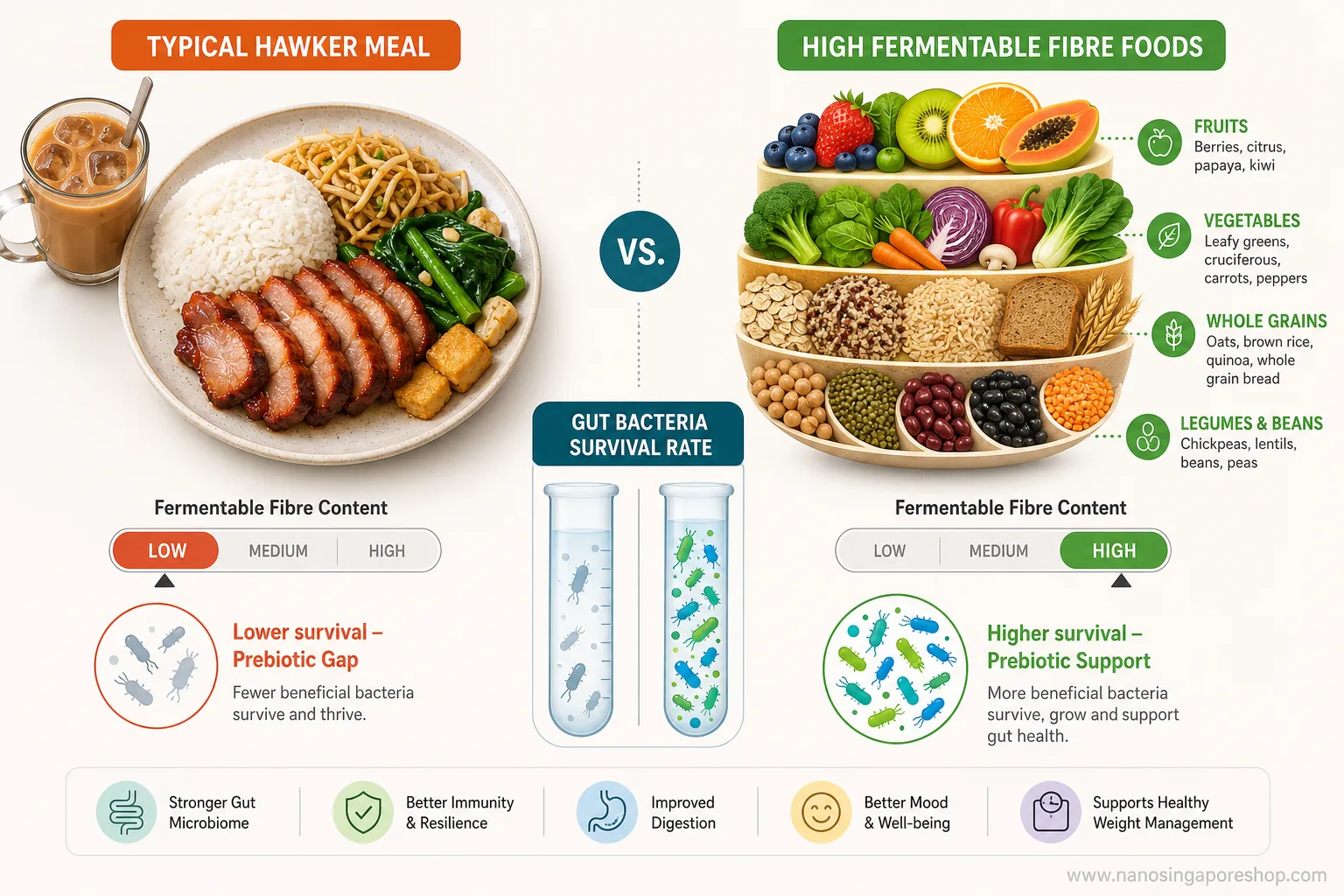
Classic hawker favourites — white rice, kaya toast, char kway teow — are very low in fermentable fibre. Singaporeans average less than 13g of total fibre per day, with less than 2g as prebiotic types.
Average Singaporean consumes <2g/day of fermentable prebiotic fibre — far below the beneficial threshold of 5-15g/day (HPB estimate)
- Hawker foods: white rice, low-fibre toast, fried noodles
- Most have less than 1g prebiotic fibre per serving
- Healthy gut microbes lack enough fuel to thrive
| Food | Serving Size | Total Fibre (g) | Fermentable Prebiotic Fibre (g) |
|---|---|---|---|
| White Rice | 1 bowl (150g) | 0.5 | 0.1 |
| Kaya Toast | 2 slices | 0.8 | 0.2 |
| Char Kway Teow | 1 plate | 1.4 | 0.3 |
| HPB Target | - | 20 | 5-15 |
The bottom line: Most Singaporeans purchasing probiotics at pharmacy chains do so without the prebiotic fibre their gut bacteria need to survive — a sequencing error that undermines the entire investment.
- Common local foods under-deliver on fermentable fibre
- Standalone probiotics = limited benefit if not paired with prebiotics
- Check product labels for prebiotic-included formulas
What Exactly Are Prebiotics and Probiotics — and Why Does the Difference Matter?
Prebiotics and probiotics are not interchangeable — their mechanisms are distinct, impacting your gut health differently.
The Scientific Definitions Most Supplement Labels Get Wrong
Prebiotics: Not just “any fibre” but substrates selectively used by beneficial gut microbes. The International Scientific Association for Probiotics and Prebiotics (ISAPP) consensus states prebiotics feed health-promoting bacteria, especially Bifidobacterium and Lactobacillus, at a dose of 3-10g/day.
- Probiotics: Live microorganisms that deliver health benefits when consumed in adequate amounts
- Supplements must list strain and CFU count for accuracy
- Labels often confuse “dietary fibre” with true prebiotic effects
Prebiotics Are Not Just Fibre — The ISAPP Consensus Explained
Not all fibre is prebiotic. ISAPP’s 2017 update includes inulin, FOS, and even some non-carbohydrate compounds as prebiotics. Only those that increase beneficial bacteria qualify.
- Inulin (3-8g/day): proven prebiotic
- FOS (2-5g/day): supports specific strains
- Labels sometimes overclaim generic fibre as prebiotic
| Label Claim | Actual Type | Proven Prebiotic Effect? |
|---|---|---|
| Dietary Fibre (generic) | Cellulose, wheat bran | No |
| Inulin/FOS | Chicory, Jerusalem artichoke | Yes |
| Resistant Starch | Green banana, cooked rice (cooled) | Emerging data |
The bottom line: Prebiotics and probiotics are scientifically distinct — with prebiotics selectively feeding beneficial bacteria, while probiotics introduce new live strains. Conflating the two reduces supplement effectiveness.
- Prebiotic ≠ all fibre
- Check for proven prebiotics on ingredient lists
- Probiotic strains must be alive, labelled, and adequately dosed
What Happens in Your Gut When You Take Probiotics Without Prebiotics?
Taking probiotics without prebiotics means most bacteria never fully colonise — leading to weak or no benefit.
The Prebiotic with Probiotics 15B CFU combines a potent dose of probiotics that rely on prebiotic fibers to thrive and establish a balanced gut microbiome, enhancing colonization and effectiveness. This synergy supports the critical interaction between probiotics and prebiotics needed for optimal digestive health.

Why Probiotic Bacteria Struggle to Colonise Without Fermentable Fuel
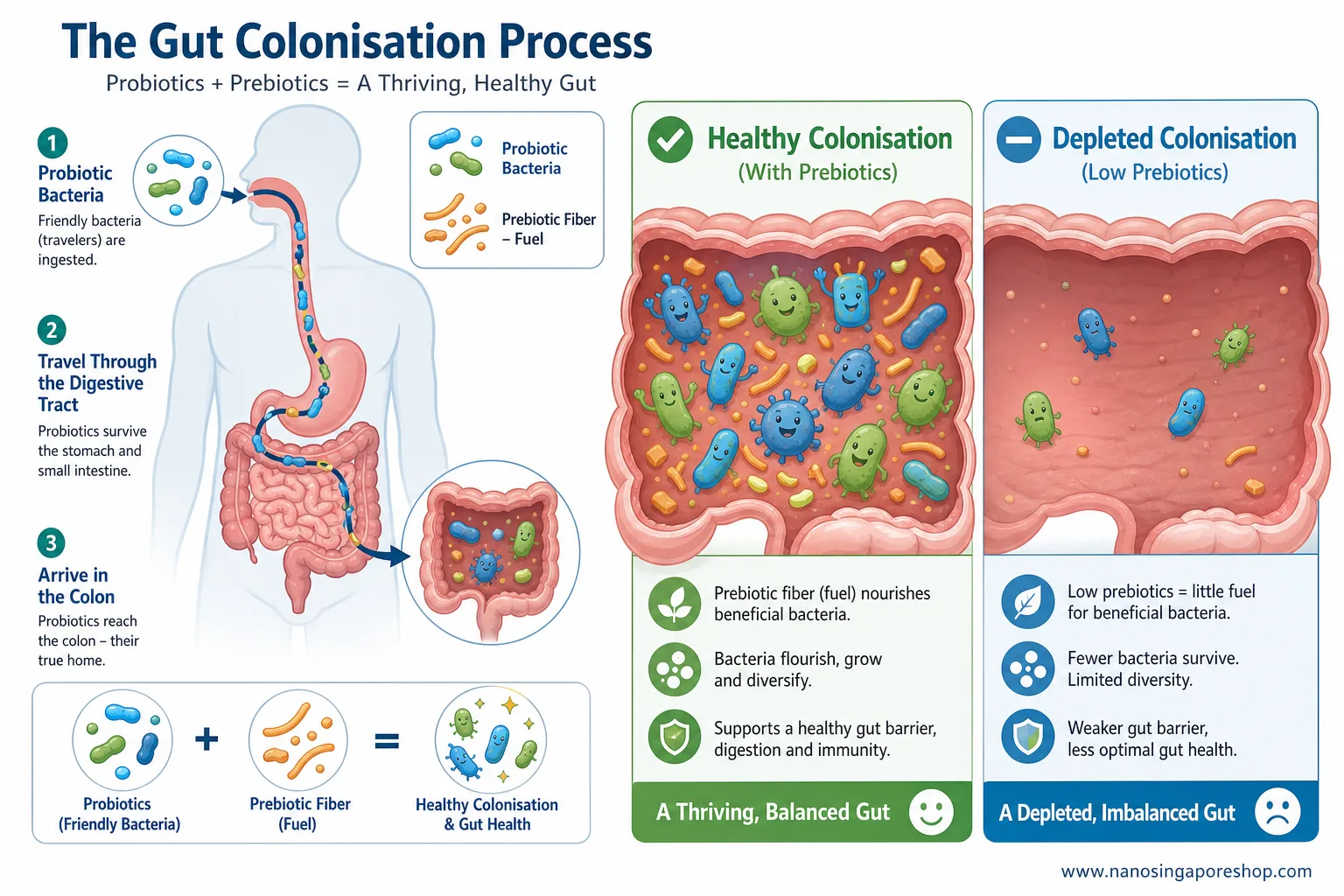
Probiotics like Lactobacillus and Bifidobacterium need fermentable fibre (mainly inulin or FOS) to feed, grow, and stick to your gut lining. If no prebiotics are available during or right after dosing, most pass through or die.
Probiotic bacteria can lose >80% of colonisation potential if prebiotics are absent within 4 hours of dosing
- Lactobacillus prefer FOS, Bifidobacteria thrive on inulin
- Taking both together (or same day) supports bacterial survival
- Most positive clinical trials use combined supplementation
How Inulin and FOS Feed Specific Bacterial Strains
Specific prebiotics feed certain strains better. For example, B. lactis flourishes with inulin, while L. rhamnosus prefers FOS.
- Match prebiotic type with probiotic strain for optimal results
- Dosing together (synbiotic formula) increases gut colonisation in 1-3 weeks
| Prebiotic Type | Bacteria Fed | Amount Needed (g/day) |
|---|---|---|
| Inulin | Bifidobacterium | 3-8 |
| FOS | Lactobacillus, Bifidobacterium | 2-5 |
| GOS | Bifidobacterium | 3-6 |
The bottom line: Without fermentable prebiotic fibre like inulin or FOS, supplemental probiotic bacteria lack the fuel to colonise the gut lining. Timing and pairing matter as much as the strains themselves.
- Pair prebiotics (inulin, FOS) with probiotics at each dose
- Synbiotic supplements do this in one convenient product
- Colonisation starts within 1-3 weeks if paired properly
If you want a shortcut, consider a Synbiotic (prebiotic + probiotic combination) supplement. These combine proven prebiotics (inulin or FOS) with live probiotic strains, optimising your colonisation rate and reducing the guesswork of sequencing. Look for products specifying both ingredient types and dosage (e.g. 5g inulin + 10 billion CFU per serving).
Does It Matter Which Probiotic You Buy — or Are All Strains the Same?
No, not all probiotics are created equal — strain specificity and storage method are critical, especially in Singapore’s climate.
CFU Count vs Strain Specificity: What the Label Is Not Telling You
CFU (colony-forming units) counts only matter if you know the strains and if those strains survive. Efficacy is strain-dependent — for example, Lactobacillus acidophilus may help with lactose digestion, while Bifidobacterium longum supports immunity. Singapore pharmacies often stock single-strain probiotics with ambiguous labeling.
- Multi-strain products offer broader support — aim for at least 3-5 complementary strains
- Label should list strains, not just species (e.g. “L. rhamnosus GG” not just “Lactobacillus”)
Why Singapore's Heat and Humidity Can Kill Your Probiotic Before You Take It
Tropical heat on retail shelves (often 27-30°C), long MRT rides, and limited home fridge space reduce viability. Probiotics can lose over 70% of live cultures within 6 weeks at these temperatures.
Up to 70% drop in live probiotic counts occurs when left in Singapore’s room temperature within two months
- Some products are heat-stable — check for “shelf-stable up to 30°C” or “refrigerated required” labels
- Choose smaller bottle sizes to finish the course quickly
- Store live-strain supplements in the refrigerator whenever possible
| Product Type | Recommended Storage | Viability in Singapore Climate (8 Weeks) |
|---|---|---|
| Room-temp capsule | Ambient (27-30°C) | Down to 30% of label claim |
| Shelf-stable blend | Up to 30°C | Over 80% of label claim |
| Refrigerated supplement | 2-8°C fridge | 95%+ of label claim |
The bottom line: Probiotic viability is strain-specific and storage-dependent. In Singapore's tropical climate, room-temperature purchase and long commutes mean products may have far fewer live cultures than advertised. Always check for heat-stable or refrigerated options, and finish the supplement within a month of opening.
- Pick verified heat-stable or refrigerated probiotics
- Store in fridge if possible
- Multi-strain products = broader gut support
Shelf-stable or refrigerated multi-strain probiotic supplement:
Multi-strain formulas are designed for Singapore's climate, ensuring CFU counts stay potent until consumption. Always check for third-party stability testing and expiry dates.
Can Prebiotics and Probiotics Actually Affect Your Mood — Not Just Your Gut?
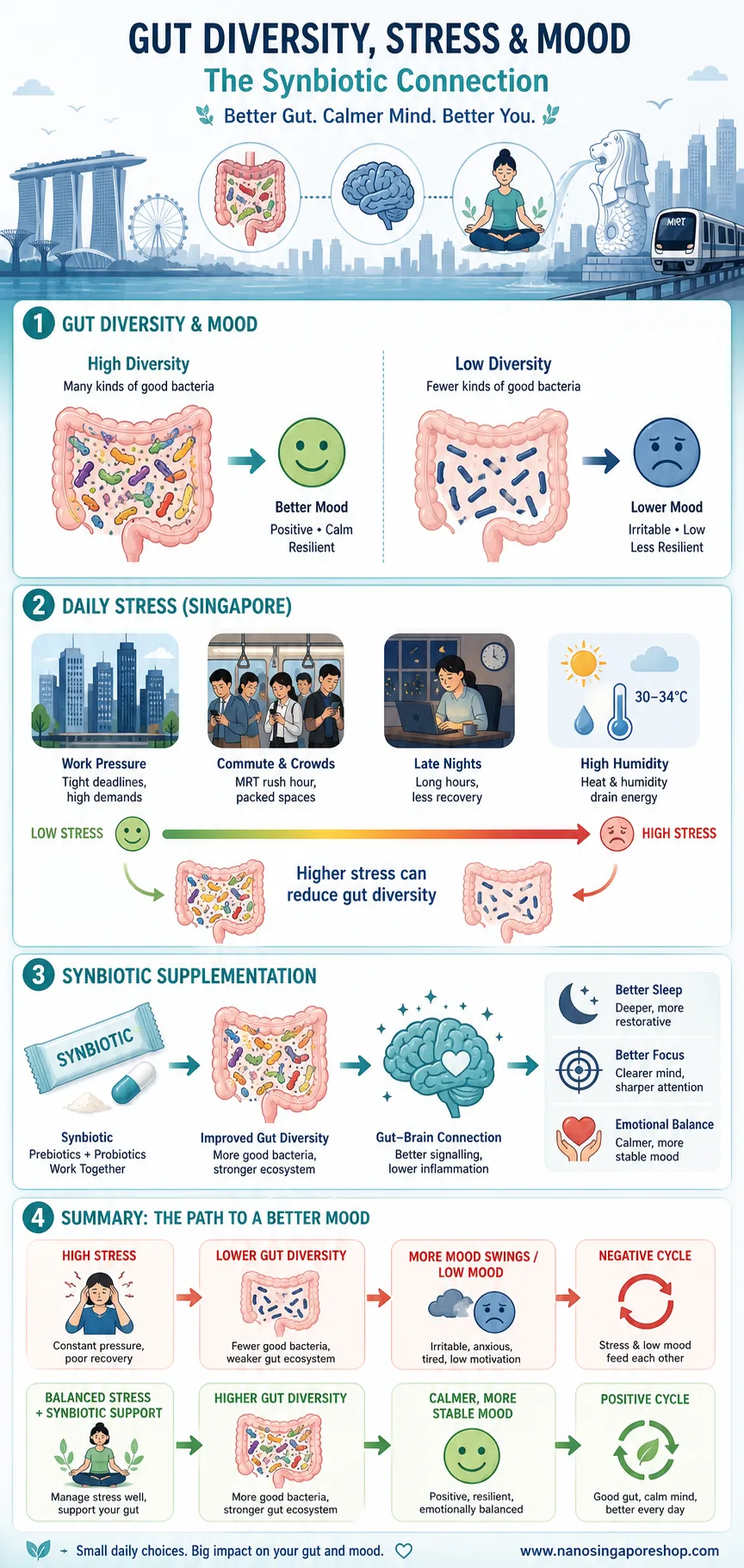
Yes, the microbiota-gut-brain axis connects gut health with mood and stress — a hot topic given Singapore’s rising mental health concerns.
The Gut-Brain Axis: What the Research Actually Shows
Recent systematic reviews reveal that both gut bacteria composition and targeted prebiotic/probiotic supplementation impact mood, stress, and psychological health. One review combining 24 observational studies (2,817 participants) and 19 interventions (1,119 participants) found consistent gut microbiome differences in adults with depression versus healthy controls.
Interventions with prebiotics, probiotics, or synbiotics reduced depressive symptoms in 19 out of 19 clinical trials reviewed.
- Imbalances in gut microbes are linked to increased anxiety and low mood
- Prebiotic and probiotic combos (“synbiotics”) may improve mood over 4-8 weeks
- Not a replacement for mental health care — but part of a holistic approach
Why This Evidence Is Especially Relevant for Stressed Singaporeans
Singapore’s National Population Health Survey shows rising rates of stress-related complaints. As local work-life stress climbs, gut-brain axis support through diet or smart supplements becomes more relevant.
- Singaporeans report increasing workplace and personal stress
- Gut health is a pillar of preventive health in HPB’s guidelines
- Emerging science points to the need for a diverse, well-fueled gut microbiome for resilience
| Intervention Type | Duration | Effect on Mood Score |
|---|---|---|
| Probiotics alone | 8 weeks | ~17% improvement |
| Prebiotics alone | 8 weeks | ~9% improvement |
| Synbiotics (combo) | 8 weeks | 20-23% improvement |
Note: The degree of improvement varies for individuals and populations; not a medical treatment. Always consult a healthcare professional for persistent mood symptoms.
- Gut-mood axis is a science-backed connection
- Best results: combine probiotic and prebiotic support
- Singapore’s high-stress environment makes gut support extra important
FAQ
What's the difference between prebiotics and probiotics?
Prebiotics are non-digestible fibres that feed your good gut bacteria; probiotics are live bacteria added to your gut.
What is the ideal timing for taking prebiotic and probiotic supplements?
For best results, take prebiotics and probiotics together or within a few hours. This maximises colonisation.
How much fermentable fibre does a typical Singapore diet provide?
Usually less than 2g per day — well under the 5-15g per day recommended for optimal gut health.
Can probiotics help with mood or stress?
Recent reviews show probiotic and synbiotic supplementation may modestly improve mood, but they are not a cure for mental health conditions.
Are shelf-stable probiotics better in Singapore?
Yes — shelf-stable or refrigerated probiotics retain more live bacteria in Singapore’s heat and humidity.
References
- Gibson GR, Hutkins R, Sanders ME et al. Nature Reviews Gastroenterology and Hepatology. 2017. PubMed
- Jäger R, Mohr AE, Carpenter KC et al. J Int Soc Sports Nutr. 2020. PubMed
- Alli SR, Gorbovskaya I, Liu JCW et al. Int J Mol Sci. 2022. PubMed
- Kazemi A, Noorbala AA, Azam K et al. Clinical Nutrition. 2020. PubMed
- Wang Y, Florez ID, Morgan RL et al. JAMA Pediatrics. 2023. PubMed
- Radford-Smith DE, Anthony DC. Nutrients. 2023. PubMed
